High Tide
The current rules in Scotland dictate that I cannot enter my daughter’s house but we can go for a walk together. This we decided to do, Kate and I, accompanied by my grandson, Felix, and his friend from across the road. They trailed along behind throughout, heads full of Lego figures, Ninjago and Minecraft. We walked through the woods, across the ever more bleakly spreading housing development, then down the lane to Belhaven. The first location of Dunbar’s harbour was here, where Biel Water flows out into the bay and the Firth of Forth.
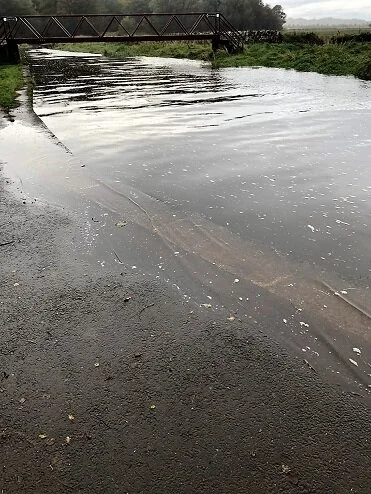
When we reached the estuary we were surprised to see it brimful, the waves surging in, washing high up the sea-wall and flooding the surrounding marshland. The tide pushing back up Biel Water flowed over the pathway at one point. Kate took this picture.
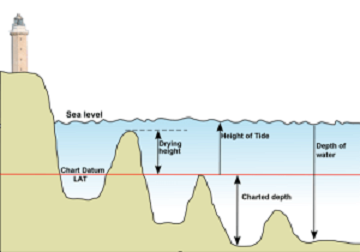
I usually have an idea of when high and low tides occur, the information gleaned from Scottish Tide Times and Tables, a little booklet I have bought annually from the local newsagent since I moved north of the border to live by the sea. I have never taken much notice of tide heights, though. On this particular day, I later found out, the tide here was at its highest for the year, reaching 6.2m…almost 20 feet above Chart Datum, which is the notional average for low tide in any particular location.
We continued our walk along the riverside path, then through West Barns out into the open fields, the boys bringing up the rear. A charm of goldfinches cascaded along the hedgerow, and we saw an almost-murmuration of starlings, a large flock strung across the sky not quite performing the acrobatics we were hoping for. Back at Kate’s house I bade them farewell, from the doorstep of course.
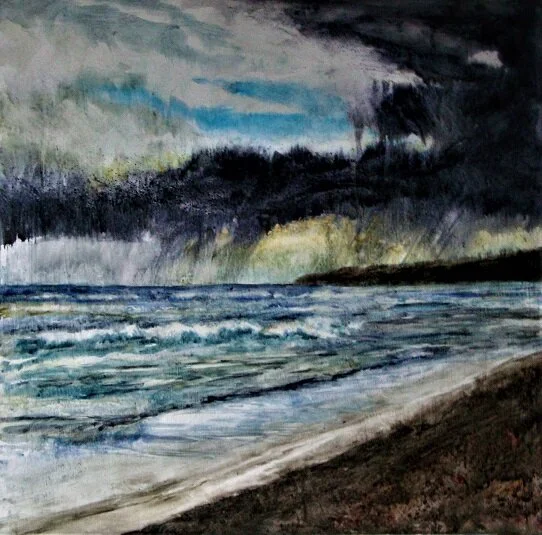
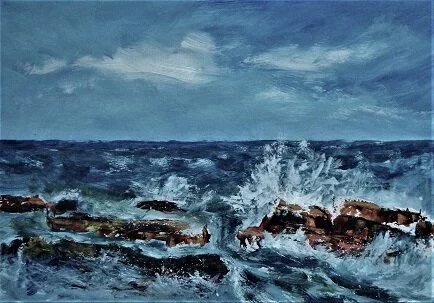
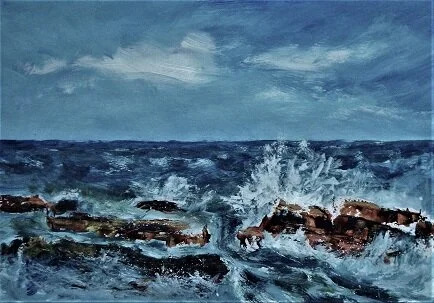
The following day at high tide I walked along the shore path below my flat eastwards towards White Sands. The path is an extension of the John Muir Way and links up with the Southern Upland Way a few miles down the coast at Cockburnspath. As I set out, the vigorous swell of the sea was already pounding against the stone walkway which I took for the fun of it, the spray flying several feet above my head. I soon had wet feet. The path then skirts the length of Dunbar Golf Club. The waves washed up to the very edge flinging spume onto the golf course. Even the single-minded golfers paused on the putting green to gaze at the inundation.
I was more interested in a flock of wintering turnstones trying to cope with the tide. At each wave’s retreat they descended and hastily poked around in the pebbles, only to be flushed away by the next surge, taking off with an indignant twittering, their white markings flashing out like a sparkling fan. And the rock pipits, our resident, somewhat unobtrusive, small shore bird, didn’t know what to make of it, flitting in all directions with their thin, troubled tweets.
After a mile or so I came to the weathered rocky outcrops just off the shore (see ‘Shorelines’ — Sunday Morning) They were half-submerged. I stood on the grassy bank above the strandline and watched the breakers sweeping in. Of course, this was no tumultuous tempest or tsunami, just a very high tide. Nevertheless I felt excitement and awe at an element at a stretch, beyond our control, like earthquakes, hurricanes and maelstroms. Standing there I thought of the virus, at the microscopic end of the scale of natural phenomena, which is doing its best to resist our control. It will be the scientists quietly working away in their laboratories rather than the fumblings of politicians who will eventually rid us of this pestilence.
*
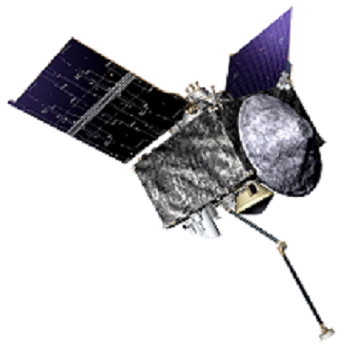
And it was scientists who, amid all our present doubts and dangers, provided us with the most exhilarating piece of news this week. I watched as they sat before their banks of screens at NASA applauding the eventual landing of a space probe on the surface of an asteroid 200 million miles from Earth. The asteroid is a lump of very ancient rock rather greater in dimensions than the Empire State Building, highly carbonaceous, and goes by the name of Bennu. The space probe, known as Osiris Rex, was launched about four years ago. Too distant for the landing to be controlled directly from Earth, the probe, about the size of a transit van, was programmed to land in a space the size of a couple of parking bays and by a quick blasting and sucking exercise collect a sample of matter before the two year journey back. It is hoped that the sample of loose rubble and surface matter (regolith) will, because of its great age, provide us with clues about the chemistry of the birth of our solar system around 4.5 billion years ago. Such feats of human ingenuity and intelligence put our generally petty and mundane squabbles into perspective.
The nametag Osiris Rex can be unpacked in the none too catchy Origins: Special Interpretation Resource Identification Security — Regolith EXplorer. It is no accident, though, that Osiris was the great God-king of the Egyptians, a god of peace and progress who went on a long journey through Ethiopia and Arabia and further distant regions to civilise the people and teach them cultivation and agriculture. One can only hope that the space probe does not suffer the same fate as its namesake, however. Osiris was murdered by his jealous brother, Set, and his body chopped up and thrown into the sea.
Osiris and Osiris

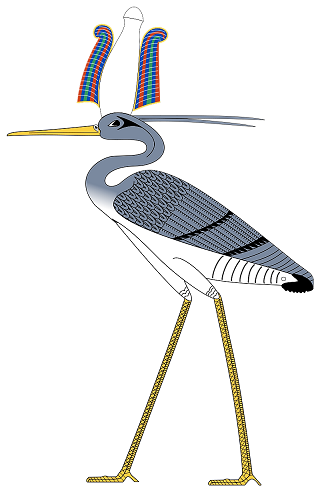
In case you’re wondering about Bennu, a nine-year-old American boy won the ‘name that asteroid’ competition with the name. Bennu was another, though rather minor Egyptian deity (how did you know this, boy?) who played some part in the creation of the world. He was said to have been self-born, somewhat Phoenix-like, and so has some affinity with Osiris who, after his brutal demise, rose again and appeared in many natural and godly manifestations. So I suppose Bennu can be regarded as Osiris’s ‘daemon’.
Bennu and Bennu

*
On ‘Something Understood’ last Sunday Morning, Christopher Lee, the playwright and historian, said, looking out on an Autumnal scene, ‘Mystery is the strongest word I know…..if it’s not about something, then it’s a big joke.’
High Tide