The Sound of Silence
It has become a lockdown cliché that we can hear birds singing. Not that they have ever stopped, just that our lives are so beset with noise that we don’t hear them. Most people in their workaday lives wade through a sea of sounds unimaginable a few generations ago. Now, the subduing of traffic by road, rail and air, and the quelling of rowdy machinery has awakened us to the quiet spaces beyond the noise. When we take our allotted daily walk we suddenly hear birdsong and are both surprised and delighted by it. We welcome the silence, which is no silence at all, but an absence of the sounds which harry us in our noisy world, play on our nerves and cause sleepless nights.

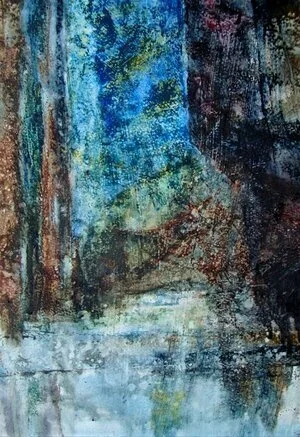
Deep
There is, though, a kind of noise that we seem unable to subdue. Aircraft might be grounded, train timetables slashed and driving drastically curtailed, but the digital twitter of the average household continues undiminished in our effort to keep in touch, and both educate and entertain our impounded offspring while the strip lights buzz and the washing-machine whirrs in the background. And some domestic noise is considerably more than a twitter. I have on occasion been subjected to the viewing habits of young children and been alarmed by the cacophony which is aimed at them — little cartoon characters shrieking at each other, multiple zappings and crashes as yet another villain hits the dust and airborne machines explode into brick walls or mountain tops. And all in violent technicolour too!
The merciless onslaught of social media keeps us glued to our phones, where the noise, apart from the odd ping as another text message strikes, is a sort of white noise, like the hum of a distant motorway, as we try to respond to the unending flow of greetings, catchphrases and flickering uploads. Like all addictions the smartphone is enticingly seductive and impossible to give up. We hate it — people try to cure themselves with a digital ‘detox’ — but we have come to depend on it.
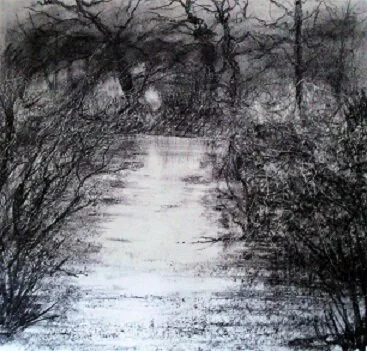
Quiet Stream
*
I wrote this poem having seen a picture in a gallery of a naked man, painted in strangely pallid colours, sitting alone in an empty room.
Green Room
The crude perspective
of a green room.
Bare floorboards. Weak light
from a grimy window.
The only furniture a small table
by the phone socket
and next to it a white chair
where sits a man,
naked, in his pale daubs of reticent flesh.
He holds the receiver to his ear.
In his other hand is raised
a mobile phone.
He waits intently, then
‘Hello,’ he says. ‘Is that you?’
‘Yes,’ he says. ‘It’s me.’
‘I’m cold,’ he says.
‘Yes. I’m cold too.’
‘I didn’t sleep last night.’
‘It’s difficult with that streetlight.’
‘It’s always like this.’
‘I think it always will be.’
‘Sometimes I hear pigeons on the roof.’
‘Or the bus going by.’
‘Do you remember when….?’
‘No.’
‘I don’t know what to say.’
‘It’s hard to think of the words.’
‘It would be different with a door.’
‘A door might help.’
‘Are you still there?’
‘I’m not sure. Are you?’
He sits for a time
listening to the crackle on the line.
Then switches off his mobile
and puts the phone down.
He stares at you out of the frame.
*
The persistent itch for communion across the digital media, the incessant buzzing of the twittersphere, has drowned out silence. Not only is it hard to find, we have come to suspect it. It is commonly ‘eerie’. Just as nature abhors a vacuum, contemporary man abhors silence. No more SILENCE notices in libraries, no sitting in silence in the classroom. If you want a bit of peace and quiet on a train you are consigned to a special carriage. And do you remember when TV shut down at a civilised hour and the little white dot disappeared on the blank grey screen? Now you can watch telly or listen to the radio all hours of the day and night and no second is left unfilled — every programme shift is crammed with adverts, trailers, jingles and sponsors’ logos. I am not a regular Radio 4 listener except for the early morning, but I do like the way you can get from one programme to another without any fuss, and how the news is announced by six little pips. I like the gaps between the pips too.
.
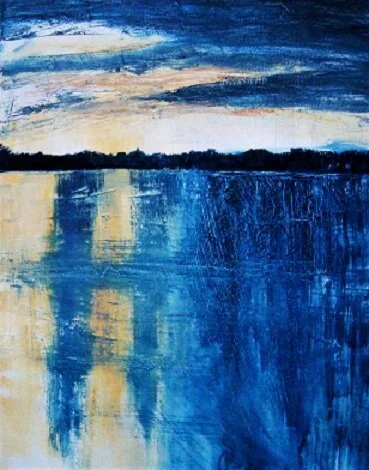
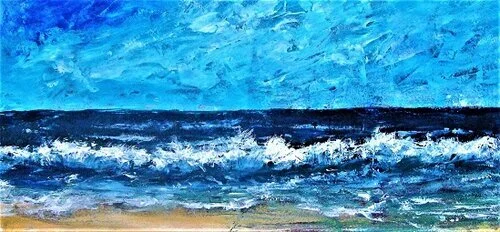
Calm Sea
*
Whatever happened to the minute’s silence? I’m thinking of a football stadium at the passing of some soccer great where tens of thousands of fans stand in respectful silence until the ref blows his whistle. Of course there is always the buffoon who bawls out some inanity, but he is met with the only meaningful response, which is yet more silence. But what do we do now? Embarrassed by silence, we clap for a minute, clap like performing seals. Will the day come when we mark Remembrance Day with cheering and whooping and whacking tin lids?
As far as I know no such thing occurred at the VE Day anniversary last week and thank heavens for that. I watched the TV at 11 o’clock as the kilted Charles and his good lady walked down the Balmoral drive to the war memorial. I am no monarchist and find the royal family faintly amusing, but I must admit to being moved by the future king’s pensive observance of the two minutes silence, before the bagpipes belched into life and the pair pottered back up the path.
It may be that this period of enforced isolation, lockdown, encourages us, now that we have heard the birds, to value quiet more and turn down the volume of noise in our lives. Or it may not…we may rush to embrace the din of the world with renewed enthusiasm. Who knows? But when the noise gets too much, whether the clamour of traffic or the babbling in our heads, we need the solace of the silence of nature, or, not silence but a different sort of sound. We go for walks in the woods and hills to take in the sounds of nature because they are, well, natural, and maybe the ancestrally honed algorithms of our DNA connect us to them in some primal way. Following the path through the wood, as much as a day spent in the British Library, is a quest for the meanings that elude us.
The Space Between
Between the wind’s rumouring
and the chime of the harebell,
the tightening night
and the skin of ice,
the leaf loosened
and the earth’s weeping,
between the lips of dawn
and the polyphony of light levelling
through the pine trees
is the space to be sounded,
the pulse to be felt,
the breath to be caught.
I watch the moment escape
down the shadows of a woodland path,
then summon my words and wait for the echo.
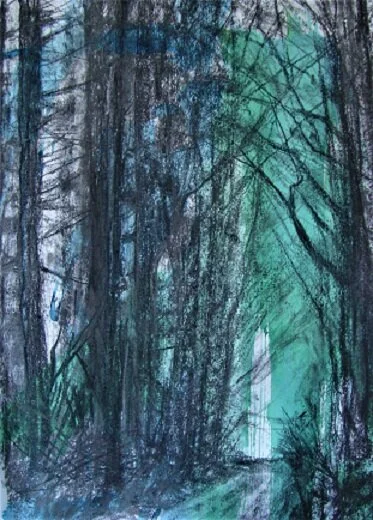
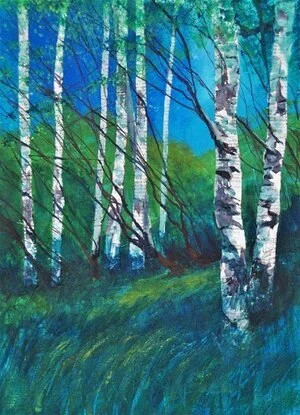
Path through the Wood
*
True silence is an illusion. It was to demonstrate this and as an antidote to the ‘noise’ generally regarded as music that the composer and artist, John Cage, wrote his 4’33” in 1952. This is a piano piece consisting of four and a half minutes of silence. The pianist sits and looks at the piano for the duration, then gets up and walks out. It’s in three movements incidentally, and several pianists have made recordings of it, though as far as I know it has never been the subject of Record Review. Philosophically, it advances the idea that all sound, any sound, is valid musically. In the absence of any sound coming from the piano, the listeners tune into the rain pattering on the roof, the wind outside and their own coughings and shufflings. To explore silence further, Cage subjected himself to ‘lockdown’ in an anechoic chamber insulated from all external sound. He continued to hear noises, however, and was told that this was his blood circulating and the vibrations of his nervous system. I believe that such internment has been used as a form of torture.
Cage the artist was influenced by the painter, Robert Rauschenberg, who produced, the year before 4’33”, a series of ‘White Paintings’, a sort of visual silence. Viewers observed that the shades of white altered with the changing light and their own passing shadows.

Robert Rauschenberg’s White Painting (1951)
*
It seems, then, that complete silence, at least to the human ear, cannot exist. Even outer space, like Caliban’s isle, is ‘full of noises’. With powerful radio telescopes you can hear the hiss of distant galaxies and the static of Saturn’s rings. The poet, Charles Tomlinson, once said that ‘beauty defines itself against the dirt’. So, silence defines itself against the noise. There is a particularly poignant illustration of this in this diagram, headed The End of the War:
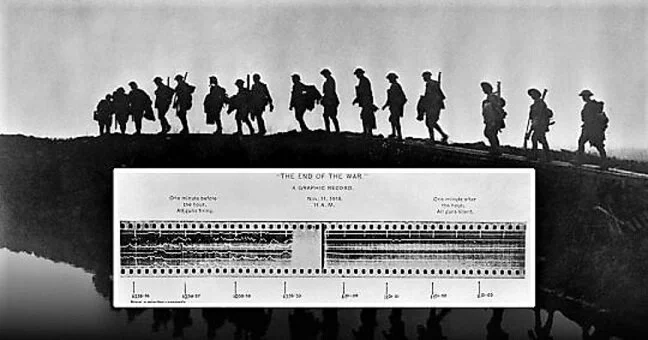
It is a read-out of sound vibrations recorded on the Western Front on the morning of Nov 11th, 1918. The vertical line down the middle is 11 am. You can hear the actual recording on the internet. It is difficult to grasp how a minute, a statistic, plucked out of the air in a wood-panelled war office, can suddenly bring such slaughter to an end. It wasn’t as simple as that, of course. If you listen carefully to the recording you will hear one or two rogue shots after 11am. And the fighting went on regardless in places where the message hadn’t got through.
*
I end with a poem about the silence of a Quaker Meeting. You sit with the other souls present, generally in a circle and in silence. The silence that lets you hear the birds outside and the rumblings of stomachs inside. The idea of the movement, founded by George Fox in the 1650’s, is that you don’t need a hierarchy of priests and bishops to intercede between you and God. If God is all he’s cracked up to be he is perfectly capable of communicating with you directly. And so you sit in silence and wait. An exception is made if someone feels particularly called to ‘minister’, in which case they stand up and do so. Strangely, some people seem to be more often called than others. I don’t attend such meetings now. Nevertheless, a Quaker silence can be a beautiful thing. In the centre of the circle is a little table with a vase of flowers, perhaps, and other objects to meditate upon.
This Space
Take this space.
Make of it a small table
and flowers, bluebells,
in an earth jar.
Note the particular blue, then
the deeper blue shot through it.
Part the stamens, travel down,
down the stem to the utmost water
to sip and rise again
cell by cell
to breathe the different air.
Mind this space.
Find a candle and light it
so that with fire and time
its milky tallow
succumbs to feed what saddened it.
Watch how the flame from wick to centre
shivers in its flare.
Then behind closed eyes
see the unflickering image,
pure as intention,
die into memory again.
Observe this space.
Reserve in a dish three pebbles —
purple, ochre, and one streaked
with silver quartz.
As you caress the cool stone
smooth as skin
remember the intimacy of the tide’s
drag, where they kissed.
Understand the patience
of ageless oceans,
the discipline of slow skies.
Hold this space.
Enfold the silence in it.
Not the sound’s absence
but the stillness
at the heart of sound, coming
through the open door —
the rap of rain on stone flags,
the chide of the wren in the hedge bottom.
Hear the silence pierce the noise.
Find how it speaks
when questing words must cease.