Still Life
I am sitting on my sofa reading a book. If I look up and out of the window I can see sky and sea. The elemental world out there, into which I often venture, the world of water, stone, wood, air. There I’m in my element, so to speak. Something connects me to that world of nature — whether by atoms, by millennia of human evolution or some idiosyncratically cultivated mentality I do not know. Yet, however much I am drawn to the world of nature, I am not feral. In Charles Frazier’s fine book, ‘Cold Mountain’, Inman, returning from the American Civil War through the hills, comes across an old woman living alone in the wilderness. She dwells in a little shack with a few goats and some friendly ravens. Her small room is a clutter of animal pelts, bones, drying herbs and other gatherings from nature. She draws and writes down everything she sees and does, keeping track ‘of what everything’s up to.’ When she dies she will be happy for her ravens to ‘peck her apart and carry her away’. I admire her self-sufficiency and resilience but I could not endure the sadness of such sustained isolation. I love the solitude of a day out walking and exploring, but I am domesticated enough to want, to need, a home to return to. And I am happy for the elements to circle around my home and beat at the brickwork of its outer shell, but not for them to come in.
Still Life
Inside the brickwork, my walls are further defended by ramparts of pictures, bookshelves, cd racks, the sideboard….and there, sitting on the sofa, is me, with my outer shell of skin, my bones, my cavities and somewhere deeper still, me — myself, that is, the one who is looking out the window and dreaming all this up. My home as refuge, my castle, a hill-fort protected by multiple palisades and ditches.
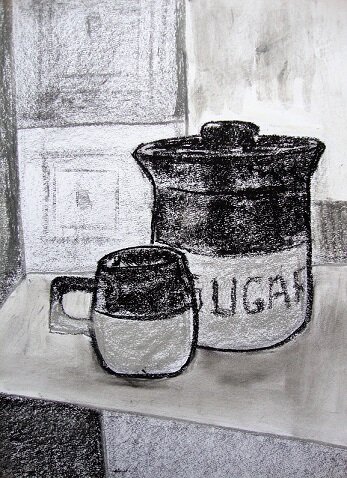
Sugar Tub and Beaker
I look around this room and realise how much it echoes who I am. It wraps around me like a favourite woolly jumper. Not that I set out to create an ‘effect’ — my daughter will tell you that I have no sense of style or colour when it comes to walls and curtains and carpets. Take my sofa, for example, greeted with snorts of derision from my offspring when I bought it. They referred to it as ‘an old granny’s sofa’. But I needed a new sofa, my old one which was second-hand anyway having collapsed beneath me. I went, therefore, to Sofas R Us and found that those on display were either bleakly minimalist, all straight lines and low backs, or vast pillowed receptacles designed for people the size of a van. The only one I could sit on comfortably, lean my head against, with arms I could reliably rest mine on was a dull beige colour with a pale pattern of foliage and tendrils drifting over it. That was the one I brought home.
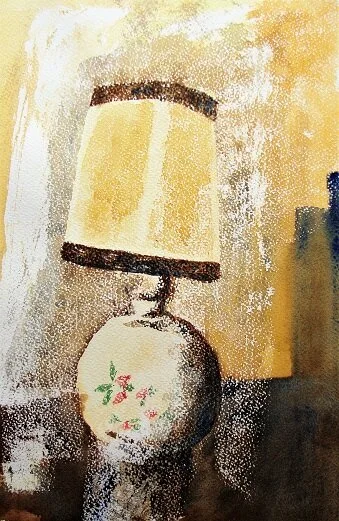
Lamp
No, my room is just an accumulation of my life so far: books, pictures, cd’s, photographs of the grandchildren on the mantlepiece. I sit on my sofa surrounded, protected, reinforced even, by these manifestations of my inner life. I have recently read of people who have used the period of ‘lockdown’ to have a good clearout, to declutter their houses, and the resultant spring-clean of their souls. The idea did vaguely enter my mind but soon scuttled off. I fear the process would take far too long.

Whiskey Decanter and Glass
*
Some people want their houses to be like show homes: all clean lines and colour-coordination, the artfully placed plant — they make them look so real these days — by the patio doors, the shiny stainless-steel kitchens, everything in its glossy brochure-page place. No room for dogs or children, just the two of them, wine glass in hand, sitting two metres apart, smiling across the lounge’s airy spaces.
And there are those whose homes become an arena for compulsive cleaning, hoovering, dusting, polishing. I once visited a boy in my class at his home. He was ‘troubled’, I think the term is now. I was met at the door by his mother who promptly told me to take my shoes off and led me into the sitting-room. I saw that the suite was still in its plastic wrapping even though furbished with a set of matching cushions. The boy was sitting in the chair opposite me. Every time we moved or adjusted our positions the chairs squeaked and crumpled with the sound of compressed plastic. The mother stood on guard behind the lad watching for anything she could leap on and tidy up. The meeting was not a success but I came away with some idea of where the boy’s ‘troubles’ lay.
The woman was no doubt one of those who wage a constant war with dust. Think of the endless anxiety that must cause! I am told that most dust is caused by dead human skin. Since we cannot stop dying it would appear to come into the category of things we can do nothing about. Dust will always be with us. As far as I’m concerned, if I can write my name in it I’ll give it a quick wipe.
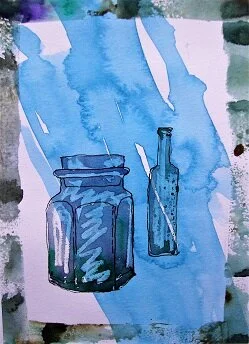
Glass Jar and Small Bottle
I had an aunt who lived in Scarborough whose house, every time we visited, was piled high with laundry. She herself was permanently stationed behind the ironing-board. The place smelt of washing powder and some substance she sprayed on the clothes before she pressed them. Her life was Sisyphean, defined by the endless task of doing the washing, and her house reflected this preoccupation. Another aunt, a ‘great’ one I think, lived in a flat in Headingley and had been a cook at Beckett Park College. Her home was characterised by food, the smell of roasting and baking. We’d have dinner sitting round the immaculately set table. No sooner had we got through our roast beef and Yorkshire puddings and I had insisted on doing the washing-up, than tea would appear. It arrived on a three-tiered trolley laden with flans, scones, cakes and assorted pastries. Her mission in life was to feed people and her home was redolent of it.
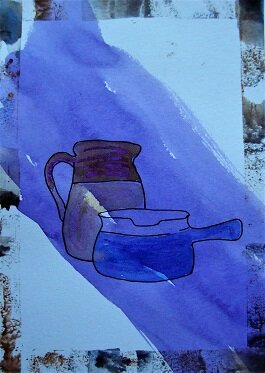
Brown Jug and Gravy Dish
I do not on the whole like those voyeuristic programmes which expose the lives of the less fortunate to public scrutiny but once I found myself watching with guilty fascination an item about a compulsive hoarder, an old gentleman who simply refused to throw anything away. There were mountains of empty cans, jars and cardboard packets, but mostly it was newspapers. The interviewer had to squeeze through ceiling high stacks of old newsprint to find the man seated in a little cave of papers and magazines. I cannot imagine the pathological insecurities which compelled him to live thus.
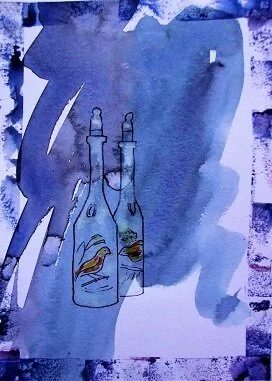
Olive Oil and Vinegar
*
I suppose my own house, or flat as it now is, being my second ‘downsize’ attempt so far, is defined by shelves. Even as a boy I had to have shelves. They were to put my models on: the Airfix aeroplanes which I didn’t find space for to hang from the ceiling by a cotton thread, the model ships and cars, even a US Army rocket launcher. I never got into model railways, much to my parents’ relief. Now I have shelves of books, shelves of cd’s, shelves for files, folders, notebooks, maps. Some items go back to the sixties when I was a schoolboy and then a student. I have never stopped adding to them. The ranks of cd’s have replaced the LPs and tapes, but this is the final format. My children try to get me to take the download route, ‘Spotify’ and so on, but I will stick to my cd’s. There is something about the compact format and the informative little booklets that come with them that I find appealing. Much to the amusement of my friends, I arrange them not alphabetically but in chronological order, so they begin, top left, with Gregorian Chant and end, bottom right, with John Adams (which shows how little I have got to grips with the avant-garde!) Besides, downloads cannot provide the extra layer of insulation from the world out there that tiers of cd’s can. My shelves are the barcodes of my cultural inclinations over the past fifty years and more.
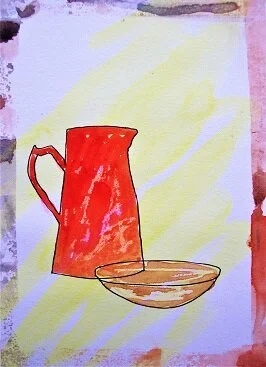
Red Jug and Bowl
*
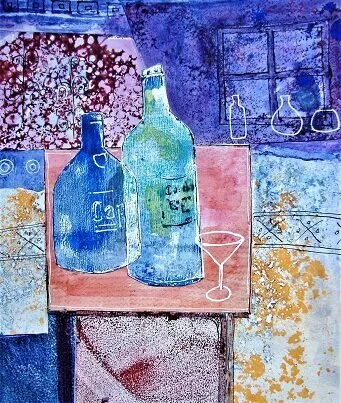
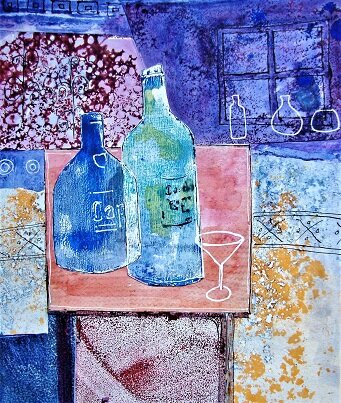
As a rule I am not much given to ornaments, but I have acquired a random collection of pots, vases and jars over the years which live — it is their home as well, I suppose — on the tops of my bookcases and cd racks. I have no idea how some of them came into my possession. That cowbell, for example, that clonks with echoes of Alpine valleys (and Mahler symphonies) and the wooden duck that peers down over ‘Much Ado About Nothing’…. where did I get them? But I now press-gang some of these items for a series of pictures and poems which I call ‘Collects’.
I have a great affection for the paintings of Giorgio Morandi (1890 - 1964). He called his still life pictures ‘Natura Morta’, hundreds of studies of jars, vases, bottles and bowls, beautifully poised, and, with the restrained colours of earth, clay, plaster, bearing an uncanny calm. Here are some of them:
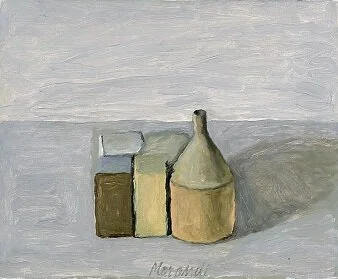
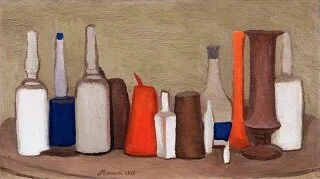
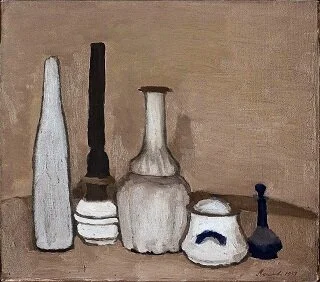
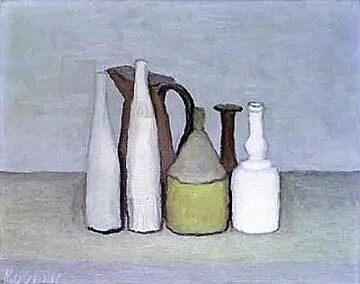
De Chirico said that Morandi’s paintings conveyed ‘the metaphysics of the commonest objects’. I cannot claim that my still life pictures do any such thing, but I do know that Morandi rather touchingly referred to the subjects of his ‘Natura Morta’ as his ‘orphans’, a word I wish I had thought of. Instead, I refer to my subjects as asylum seekers, randomly thrown up on the shores of my bookshelves, sitting alongside each other warily, for most of the time ignored. The Romans had their penates, their household gods, which merged with and took the form of the domestic objects themselves. My asylum seekers serve as my penates. I present these pictures and accompanying poems as votive offerings to whatever makes home home. Slight epiphanies, collects….one for each day of the week.
*
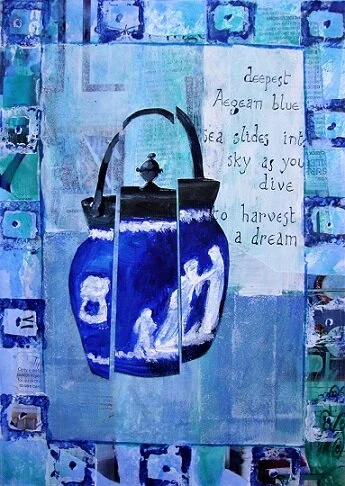
Biscuit Barrel
Aegean blue
sea slides into sky
as I dive to
recover a dream.
There, glazed by the cold
current, I find
maidens in a frieze
of white,
a frozen cornucopia,
a lyric stilled
mid-breath, Cupid
with a broken bow.

Sugar Tub
Earthen rotundity
loaded with the sweetness
of a kiss.
I dip my finger in,
lick it and see
which way love blows.
No use for sugar now,
I fill you with flour or rice,
or pen-tops and rubber bands,
a handful of drachma,
old Christmas-cracker jokes,
a broken comb, a ring.
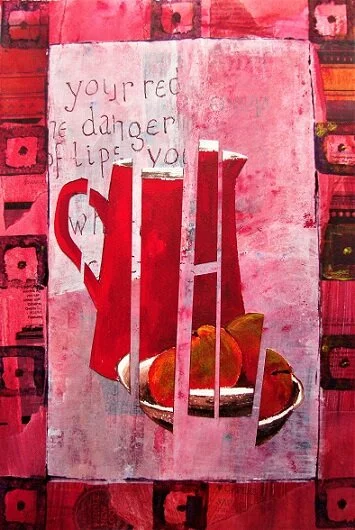
Red Jug
Your red is the danger
of lips, your white
the coolness of milk.
I am surprised by
what you can brim with,
what can spill from you….
though you wouldn’t know,
not now, as you serve
time on the windowsill
under the quiet scrutiny
of light moving round
the garden beyond.
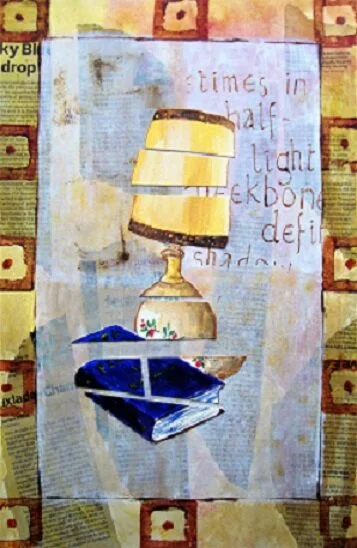
Table Lamp
Sometimes in half-light
there’s a beauty missed
in broad day.
A cheekbone defined
against a shadow,
the eye that beckons
from the shade.
As you wait on the shelf
by the old books
how rarely I turn you on,
preferring the fluorescent tube
that glares from the ceiling.
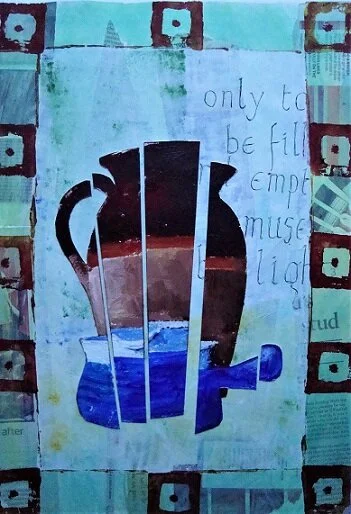
Brown Jug
To have me slap you
down, my fingers
wet you, pound and pummel,
then turn you and tease,
my thumbs impress you,
shaping and trimming,
my eye make you honest —
content now, I hope, just
to be filled and emptied,
amused, perhaps, by the bright
patch of sky that
clings to your glaze.
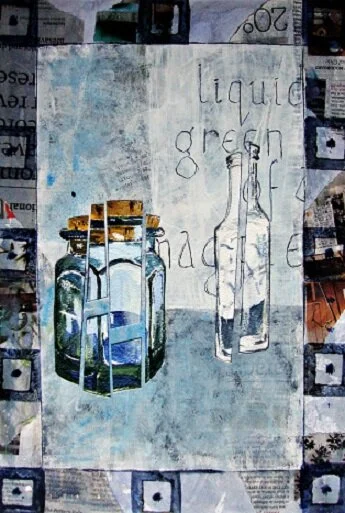
Glass Jar
Liquid gleam of a stream
over moss or the sheen
of a magpie’s wing
flows and flies
to another shore where
you sit cross-legged
on the shingle
smiling, head inclined,
waiting but not wanting,
staring me out.
The glass jar on the shelf
is stoppered with cork and empty.
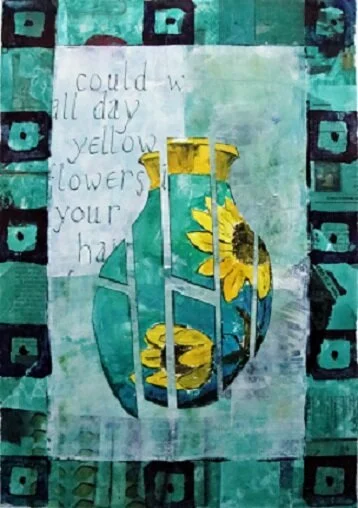
Vase
You could wait all day
at the corner,
yellow flowers in your hair,
a touch of colour
to your lips,
holding yourself just so
as light surrenders to dusk
and still no-one comes.
But feel the rain in the air,
watch the reflections,
listen to the footsteps,
hear me calling.