Rock
I am treading a narrow path along the cliff top. The air feels particularly fresh today and I appear to be alone. People usually get here by car, but in these days of Pandaemonic lockdown the car park is closed. It is therefore by devious ways that I find myself here. Below the path, thick wedges of red sandstone dip and confront the shore. Flat layers of sedimentary rock stretch out from the stony beach to disappear beneath the waves. Oystercatchers and redshank probe the rockpools, then scatter away, their piping alarm calls ringing out above the hush of the sea.
Soon I arrive at the headland where the waves roll in from the Firth, but here they make little impression except to crash spectacularly and retreat again. For I am standing on what used to be a volcano and the rocks thrust up before me are stacks of basalt ejected from the earth’s molten interior and set dark grey and iron hard.
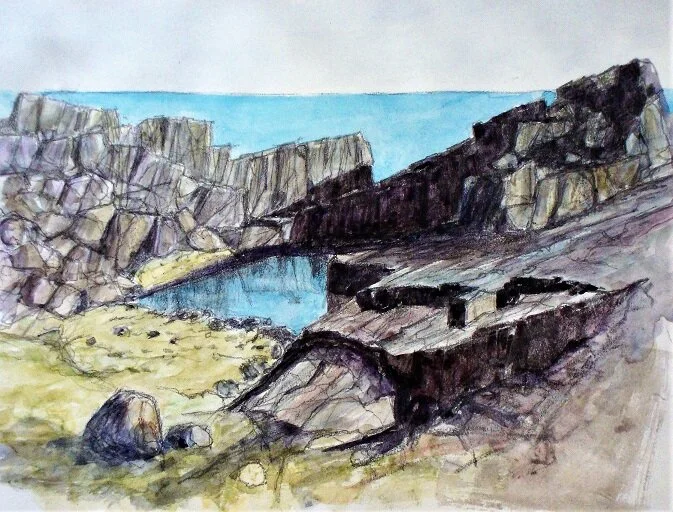
The headland…..graphite and watercolour
A few steps further and I’m standing above a deep cleft, the basalt columns rising sheer on either side. It is known as St. Baldred’s Cradle and indeed it does resemble a narrow crib, but when a big sea shovels its heady waves in they seethe up the cradle in a swirling froth. It would be a rough ride for any dozing infant. In calmer weather, though, the swell laps in and out like a gentle lullaby.
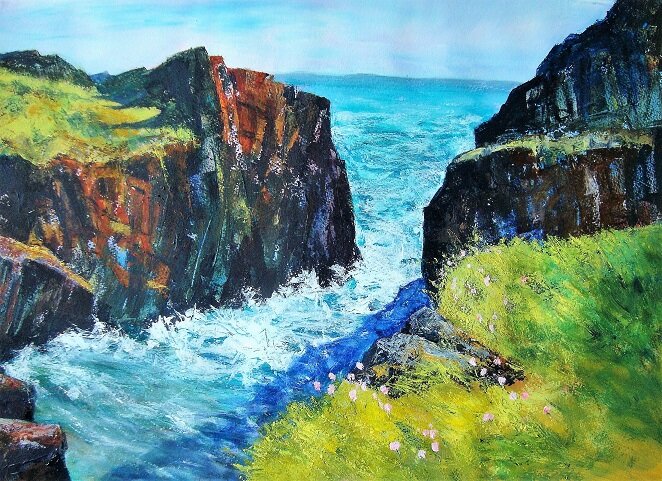
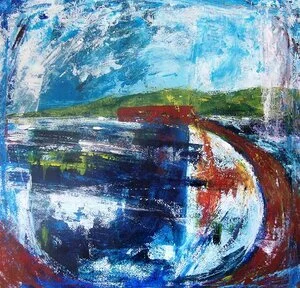
St. Baldred’s Head….an acrylic painting.
From this vantage point I take in my territory, panning round from the west: the long, empty, dune-crested beaches; Bass Rock beyond, bright with sunlight and gannets; the Firth before me working its currents into the North Sea; then eastward to the wide arc of Belhaven Bay and the estuary, where the Tyne snakes out to wrangle with the tide before succumbing, and becomes the sea itself.
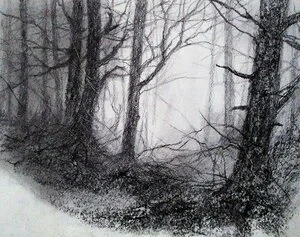
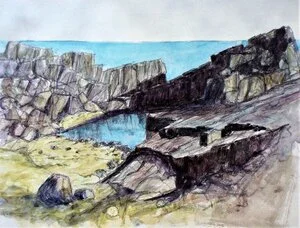
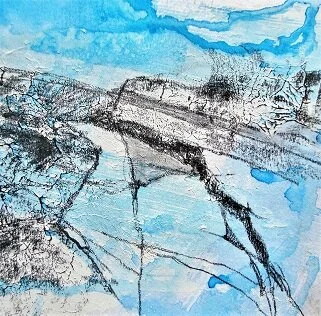
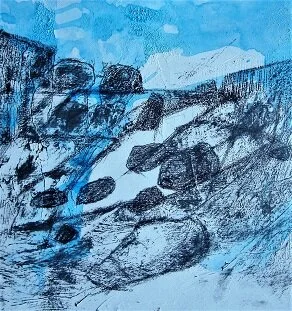
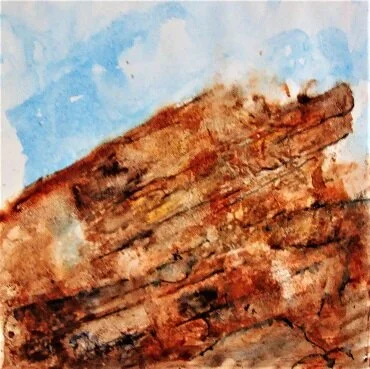
These pictures, rock studies, were a delight to do….random splashes of cerulean blue on a gesso ground, drawn into with pencils and graphite sticks.

It is but my imaginary territory, of course. It is no more my earthly territory than anyone else’s. But it is where my feet take me again and again. I am rooted to it — literally rooted, my boots stuck to the path, drawn down by the earth’s metallic core from which the headland’s volcano exploded. And metaphorically (or perhaps ‘metamorphically’) rooted; it is an attachment driven by, initially, the senses, which feed on what I see (even now with crumbling eyesight), and hear — that curlew cry again, what I smell — the aromatic sea-wormwood on the upper margins of the marsh, and what I feel and touch. An attachment driven also by curiosity about what grows, lies, flies or flits around me, and by imagination, which the shoreline serves with so many creative ideas for drawing, writing, thinking.
And, most mysteriously of all, it is an attachment driven by emotion — the way that particular lineation of shore, rock and plantation, or that unique cast of light over the estuary or the brooding sea, delivers a knock to the heart in a sort of awakening, as though I have accidentally tuned into nature’s wavelength. I think of Wordsworth’s ‘spots of time’, when the natural world is somehow invested with deep feelings and desires, and Gerard Manley Hopkins’ ‘inscape’, the notion that every living thing has its own dynamic identity — he uses the wonderful verb ‘selves’ to describe the process. We can access this ‘inscape’ through ‘instress’, an instant of imaginative energy which connects the observer and the observed like the flash between the electrodes of a spark-plug.
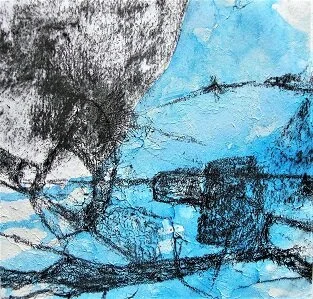
My feelings of attachment are no doubt feeble imitations of the perceptions of these great bards, but I have them nonetheless. Here are some more rock studies.
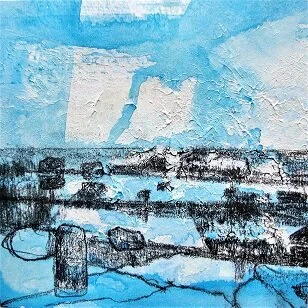
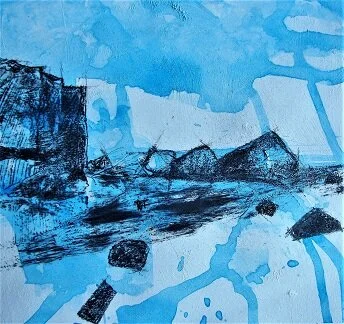
Leaving the headland I make my way by a grassy path to a little flight of stone steps and arrive at the outer rim of the estuary. Tall pines line the shore with their twisting red-brown trunks and shaggy blue-green tops. The river at low tide is a sleek eel sliding through the silty channels and the debris of boulders swept down from the uplands during the ice age.

Looking across the estuary….a quick watercolour painting
I pick my way slowly along the shore, over, round, between a variety of rocks — red, grey, honey-coloured — some smoothed and moulded by the tide, some cracking and flaking as the meticulous waves nibble away at their fine layers.
I take some photographs of rocks.
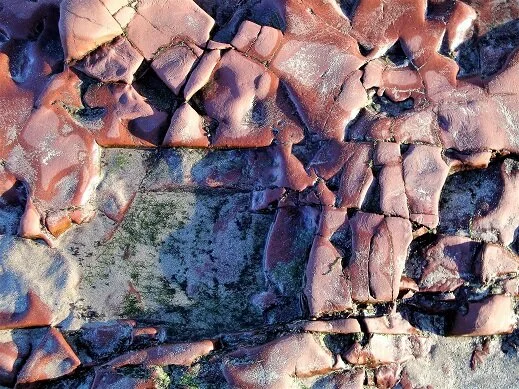
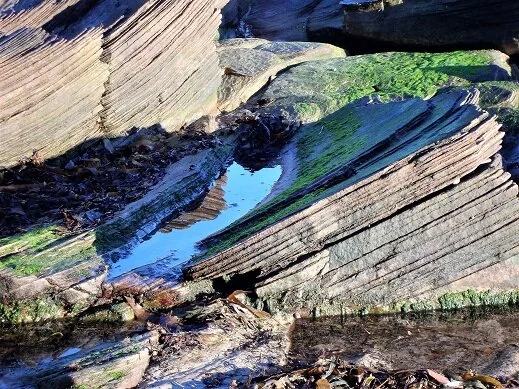
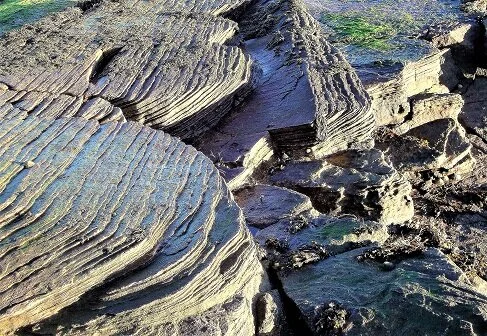
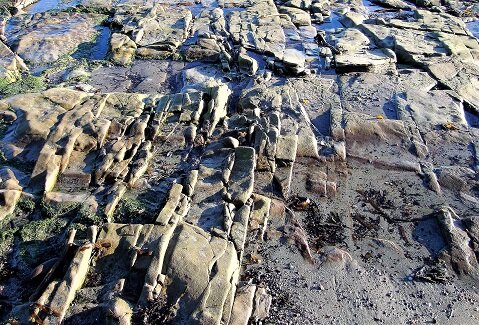
I sit on a slab of sandstone and look out across the estuary to the sandbanks and the dark green line of the plantation on the far side. The expanses of sand, shingle and rock and the breath of the tide become images for the infinities of space and time. I have alighted like a mayfly on this rock. Somehow I share its atoms, yet I am but a tiny blob of awareness and sensation in this eternity. My hand touches the edge of the rock, my fingers feeling each wafer-thin striation, millennium upon millennium.
*
Sometimes along this shore can be seen stacks of stone, rocks and pebbles of different shapes and sizes balanced one on the other to create a little tower. They are prevalent particularly in the wake of the stone-stacking competition held annually on a stony beach near the harbour….but not this year. Stonestackers from around the world come and construct their gravity defying sculptures of pebbles and rocks.
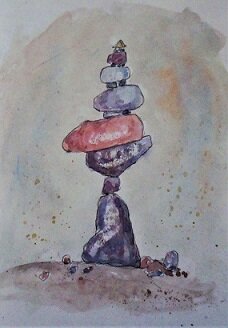
I wrote this poem having witnessed the Spaniard, Pedro Duran, conjure the prize-winning stone-stack.
Stonestacker
Beard and bandana
sun in his skin weathered
as the high sierras
he comes
to this chilly northern shore
to stack stones.
He scans the beach
a mystic in his desert diviner
of stones.
He plucks an armful
and in his little arena
begins.
His hands caress each
rock and pebble feeling
for its form and friction.
Fingers nudge and stroke
sensing every fulcrum as
the stack rises
stone on stone
uniquely placed
suspending gravity
until the final rock rough-hewn
and tapered through aeons
of wave-crash and wind-scour
is destined to tiptoe
on the smooth pebble
below.
He tests its touch contrives
the merest kiss
of stones.
The moment distils.
The lodestone stands
free its plumb line
arrowing
to the earth’s core.
His open palms
shape a blessing
in a veil of air.
The watchers clap and snap, impelled
to freeze the vanished instant.
I wander off, longing for something
in me to be clear and poised like this,
my head searching to connect,
my breath trying to balance word on word.