May Hosanna
The may is out and it seems to have come all of a sudden. Walking the other day I noticed the hawthorn heavy with its rich, creamy blooms. My first thought was of David Hockney and the paintings he did of the Yorkshire Wolds a dozen or so years ago. Many of them feature hawthorn blossom and at first I was puzzled by the way he depicted it, the white flowers hanging in long, pendulous lobes. But when I set eyes on my local hawthorns I saw that he was dead right. Many people who attempt art, me included, get sucked into painting what we think things ought to look like. Hockney, I think, seems to be able to look, see clearly and paint what he sees. He said once in an interview, ‘We see with our memory and memory is now’.
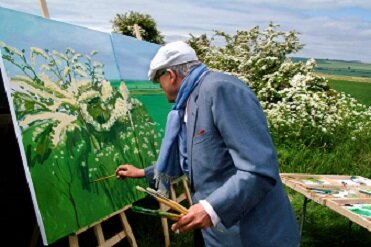
Hockney painting a hawthorn bush
I remember sitting for a long time in York Art Gallery when his ‘Bigger Trees near Warter’ was shown there and marvelling at the scale of the thing, painted on fifty large canvasses then fitted together. Not long after, I drove out to the Wolds and found the spot by the roadside where he must have stood to paint.
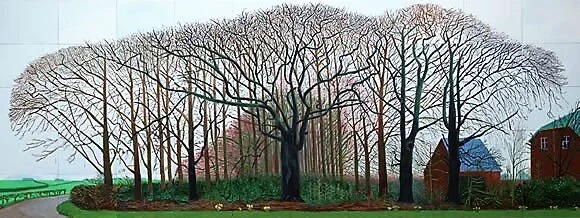
‘Bigger Trees near Warter’ 2007
It took me some time, when i lived in Yorkshire, to get round to visiting the Wolds, my hiking boots being drawn more readily to the Dales, the Pennines or the Peak District. But Hockney’s pictures and a perusal of the OS map inspired me to explore.
It is a strange landscape — a broad upland plateau stretching from the Vale of York in the west to the east coast. The underlying rock is chalk and a peculiar feature of the landscape is the proliferation of narrow, smoothly contoured, steep sided dry valleys. The characteristics of the soil, drainage and the lie of the land make for an oddly inverted agriculture, with crops grown on the upland and sheep and cattle grazing in the valleys.
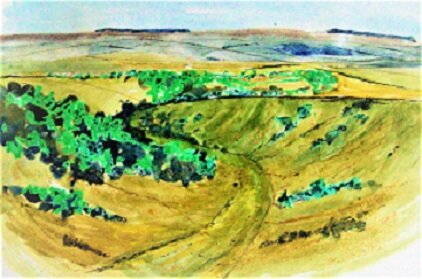
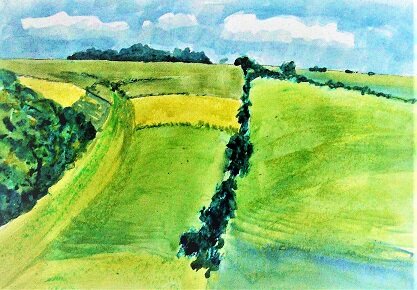
Wolds 1 Watercolour and oil pastel
I am driving out on the Hull road on a hot day in May. I turn off to Pocklington, then along ever narrowing lanes arrive at Millington Wood where there is a small car park among the trees. I notice that even here the picnic tables have not escaped the attentions, in roughly gouged capitals, of young lovers and Manchester United fans. I set out along a lane, then cross a footbridge over a trickling stream, this issuing from Millington Springs. Surface water is scarce round here. From the floor of the dry valley my chalky path takes me steeply up to the wide, open, blue skies of the plateau. The slopes are covered in drifts of hawthorn blossom and gorse.
I
May has pitched an armful of Spring snow
at the shouting wind. It has settled
and taken root in the flint
where hawthorn crowds and jostles on the steep chalk.
In the dry cobalt of noon
angels of gorse
those concentrations of hectic air
flame out their liturgies of gold.
Only a crown of trees on the hill’s shoulder
guards an almost liquid cool
where deep shadows are draughts of silence
against the burning loud hosanna in Millington Pasture.
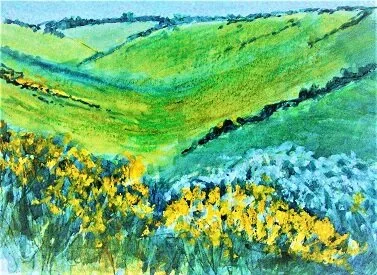
Wolds 2
I think the long, lithe shapes of the landscape are like huge recumbent beings. And then, most strangely, when I climb to the top of the next scarp and a little wood on the hilltop I am embarrassed to see a couple in the long grass beneath the trees at their pleasure. I hurry on, hoping they have not seen me — an odd inversion of guilt.
II
From somewhere earlier than praise or ecstasy
the long, close contours of these narrow valleys
show where glacial fingers pressed and rubbed
the clefts and fissures of the landscape’s giant nudes.
Numb with the effort of becoming
they sleep. Huge weight of haunches, sheer thighs,
gather to the innocent strength of a ridge
where a tiny tractor worries the horizon.
They sleep face down on beds of ancient limestone,
spur and vale in geological coma.
Scarifications of earthwork and tumuli,
the scratch of stiles and fences, do not stir them.
Up on the hill’s crown, hidden among trees,
a naked man lies over his waiting lover.
Slowly he slides into her opening body
and digs and digs till the questing limbs are still.
Earthworks along the valley side and the burr of Saxon and Norse place names tell of a land worked over for centuries. I descend to another valley where cattle graze. A sign bids me ‘Beware of the Bull’. I see no bull but keep to the fence just in case. Then, for a cool mile, I walk through the shade of a forest plantation resonant with birdsong, despite the two dead crows suspended from a gatepost.
III
Cold Skin
Scoardale
Manna Green
print on maps
guessing across centuries
Painslack
Givendale
High Callis Wold
type on buff envelopes
dropping on farmhouse mats
North Wolds Walk
Minster Way
Roman Road (course of)
package of signs and leaflets
old tracks retrod as “heritage”
Millington Wood
Picnic Site &
Nature Trail
follow the yellow posts
sit on the rustic benches
MUFC
Daz 4 Tracy
Mrs. Janet Thorpe
“who worshipped these woods
bequeathed this seat”
Twin streams of
North Yorks Water
half a mile apart
flow out in prose from
Millington No.1 Spring
Millington No.2 Spring
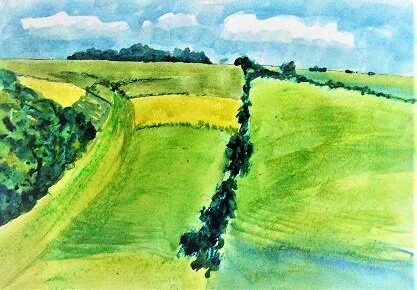
Wolds 3
I go up a track out of the rising wood to emerge into the open farmland of Huggate Wold and thence to the village of Huggate itself — a couple of farms, a steepled church, some tidily kept homes and a small council estate, a bus shelter and, round the corner, the Wolds Inn. Here I stop for a sandwich and a fine pint of Timothy Taylor’s Best Bitter. As I sit at the table outside, a troop of young men and women emerge from a farm entrance and head off through the village. Later, when I have left the pub, I see them strung out across the fields, workers from Eastern Europe, no doubt. David Hockney recalls working here — it might even have been this farm — in the summer holidays when he was a pupil at Bradford Grammar School. ‘Just walking around a field picking up stooks,’ he remembers, ‘ a little boring, but I was aware that I was in a lovely space….I do react to space. I am very aware of that.’
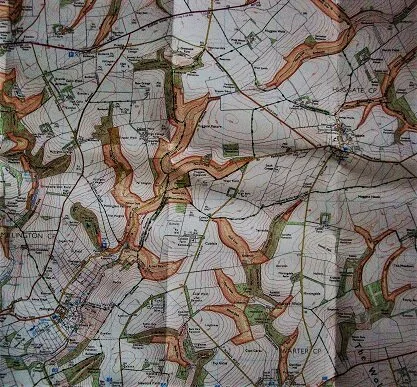
The OS map showing the tentacles of the dry valleys
I am actually on the road to Warter now, where Hockney painted his ‘Bigger Trees’ but I am not going there today. I turn off onto a long spur skirting another valley, again brimming with gorse and hawthorn, before dropping down for the last time to find the road I started out on, along Millington Vale. I pass the two springs, holy wells they must seem here where water mostly drains away. They are railed off by North Yorkshire Water and prosaically signed. With a sense of both longing and loss I pause on the footbridge and reflect on the walk behind me before returning to the car park.
IV
Springs of clearest water well
rom hidden places. Deep inside
it trickles and connects, rising
to murmur from this dank enclosure.
Oozing out it darkens grass,
inviting silt where it swells
down the hint of a gradient.
Cattle stand by a simple footbridge
where a man looks down,
his face caught out against blue sky.
Glancing up he sees the hawthorn hill,
the trees, the inert wold.
The wind has dropped
and surfaces assert cool atoms.
The hosanna’s dumb.
Leaving his reflection sliding on
he closes his map and turns away.
When I get home I start making notes for a poem, ‘May Hosanna in Millington Pasture.’

Wolds 4