Lammermuir
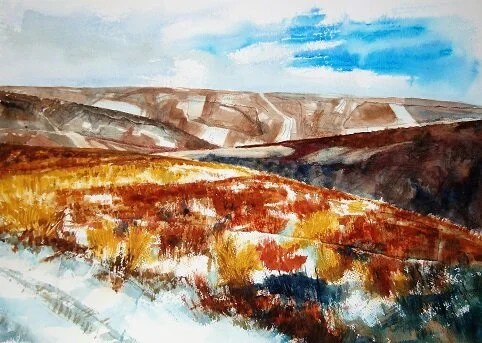
It snowed in the night but here on the coast it will not last long. Snow on the beach is a rare sight. But over the back, to the south, the distant hills are gleaming white in the winter sun.
The Lammermuirs are not spectacular hills. They run roughly east-west along a geological fault line and form a natural boundary between East Lothian and the Borders. They are smoothly contoured high moors formed from sedimentary rock around 450 million years ago. Mostly running south to north are numerous steep-sided valleys, or cleughs, carved out by glacial meltwaters. There are no striking crags or rocky scars such as you find in the Lakes or the Yorkshire Dales. They certainly do not figure as a tourist attraction — indeed, I doubt if the general public could tell you where they are.
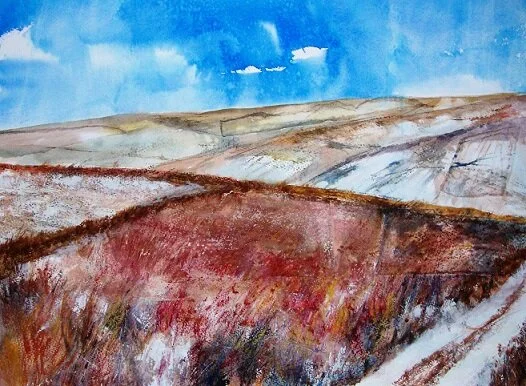
Yet there is a sense of remoteness, openness, even loneliness, you do not get in the more popular walking locations. Between the A1 in the east and the A68 in the west there are no major roads, no towns, nothing worthy to be called a village. It is a country of hill farms for rearing sheep and heather-blanketed slopes managed for grouse shooting. It is this remoteness and the feeling of a landscape going about its own quiet business that appeals to me.
*
I drive the fifteen or so miles south towards Gifford, then take the B road destined for Duns, but after a few miles veer off on an unfenced minor road to who knows where, bumping across cattle grids on the way. I park in a snowy lay-by opposite a gate. The track it opens onto leads to the broad slopes of Meikle Says Law, the highest of these hills at around 1750 feet.
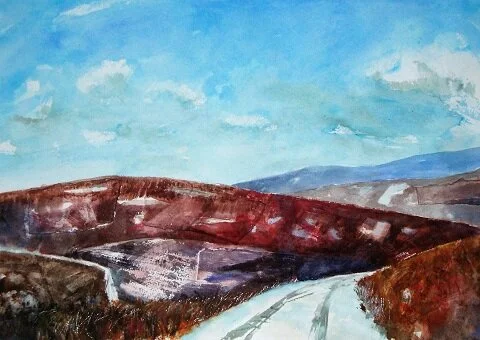
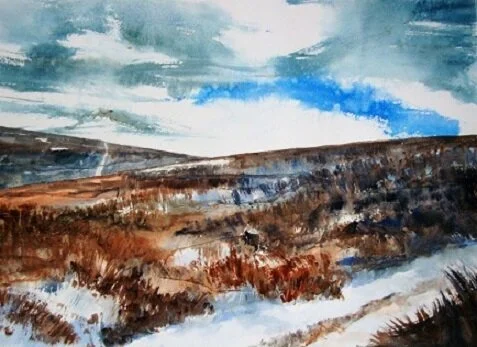
But I begin by dropping downhill to a little valley through which Faseny Water runs. I pass a farm cottage then a barn. Happily, a wooden footbridge gets me over the stream to the track beyond. Once on the gradual ascent I feel the crisp snow under my boots and begin to breathe huge lungfuls of pure, cold air, the elation of walking in the wide open spaces. Before me the snow clothed hillside, above me a winter sky of shifting harebell blue and thin veils of light cloud.
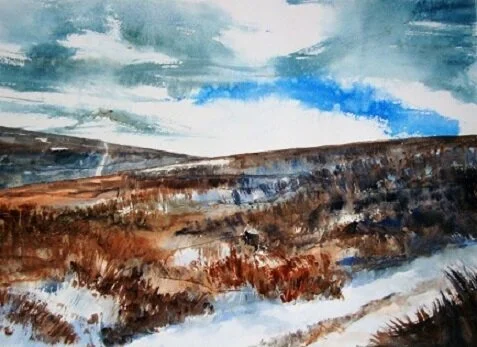
Half way into the climb, the track goes its own way, to the shooting-butts, no doubt, and all vestiges of path disappears. I see from the map that a fence runs along the summit ridge, the boundary, in fact, between East Lothian and the Borders. I plough my way through the pillows of snow covered tussocky heather till the fence comes into view. And there before me lies the somewhat surreal sight of a wind farm, gigantic turbines like nude snow goddesses, their great arms sweeping slowly round.
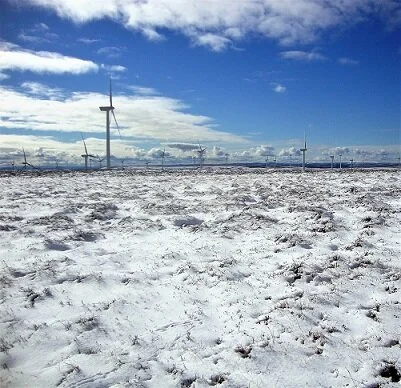
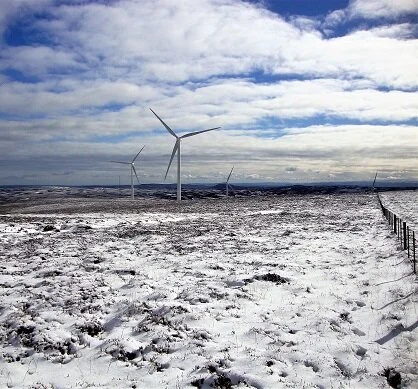
I make my slow way along the line of the fence to the eerie whoosh of the rotating blades until at last I reach the summit of Meikle Says Law and the trig. point. I stop in the bright sunshine and have some coffee from my flask. The triangulation pillar makes a convenient table.
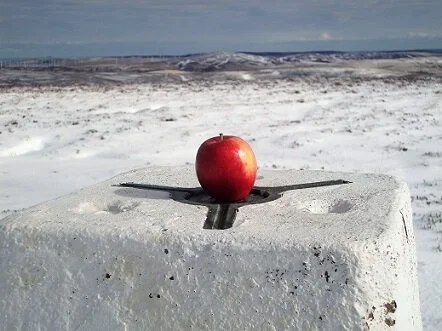
Trig. point with apple
To the north I make out the hazy coastline and to the south, beyond the turbines, the hills stretch away into the blue distance. I am aware that there is no town due south until you get to Burnley. From the summit I use my compass to set me on the return trek through the surrounding snowscape. A movement fifty yards to my left, white on white — a mountain hare bounding away and unsettling a pair of soot-black crows. By some miracle my bearing takes me to a track and I advance along the ridge of Dun Side, the upper reaches of Faseny Water down to my left, Lamb Burn on the right. I am in my element…or elements. Air — vast, cold, inspiring; earth — the ancient shales and mudstone beneath my feet and the gravel in my boot-treads; water — the rippling burns, the glistening snow; fire — the sun, all seeing, all generating. And me sharing their atoms.
The sky begins to cloud over as I descend to the footbridge once again. Over the past four hours or so I have seen no other human soul. It is with some surprise that I hear the bark of a dog and the curse of a man’s voice as I pass the farm cottage and go up the track back to my car.