Lockdown Sport
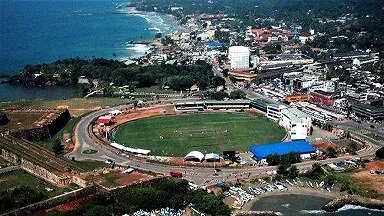
It is 4.30 on a cold, dark morning in January. The country is in lockdown and the death toll approaches 100,000. I am often awake this early these days — the hour, the day doesn’t seem to matter much. I reach out and flick on my radio in time to hear the first ball of the fourth day of the Test Match from Galle, where Sri Lanka are playing England. The Test Match Special team describe the warm subcontinental sunshine and the blue sea flickering in the distance. They are not there in person, though, but commentating via the Sky TV coverage from the individual isolation of their kitchens, attics and garden sheds. Nevertheless, the charm of TMS survives with its mixture of commentary, analysis and statistics, always with a good dose of humour thrown in. With this and the prospect of an FA Cup match between Manchester United and Liverpool later on, my day is salvaged by sport!
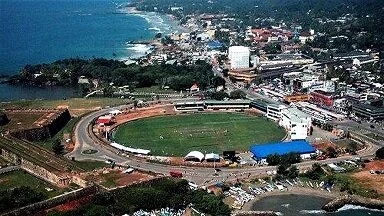
Galle Cricket Ground, Sri Lanka
I do not think of myself as a sport addict, however. The great majority of sports are of no interest to me — I couldn’t spend the afternoon watching ‘live’ bowls, for example. My likings are very partial: cricket, football, snooker, and that’s about it. And I am certainly not ‘sporty’. The joshing machismo of the dressing room is quite alien to me. I used to teach at a boys’ school where the most important subject was rugby. A good half of the staff was involved, coaching teams at one level or another. It was difficult to avoid their beefy enthusiasm. At lunchtime I would take refuge at the corner table along with the teachers of Art, Music and Greek and talk of other things.
Cricket, in its Test Match form, is, for me, the most engrossing and fascinating of games. How was it possible to devise a game which lasts five days, is governed by an endless list of arcane rules, regulations and terminology, in which for ninety per cent of the time nothing is actually happening? Yet a Test Match is like a great drama with its varied cast of characters and a plot which unfolds session by session, the balance swaying this way and that. And it is precisely the gaps in the action that allow the commentary team to describe the scene, discuss the state of the game, indulge in anecdotes and thank listeners who send them cakes!
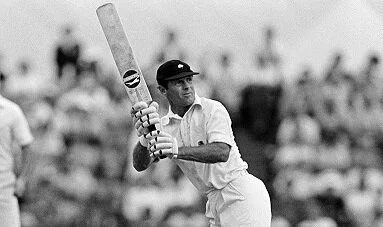
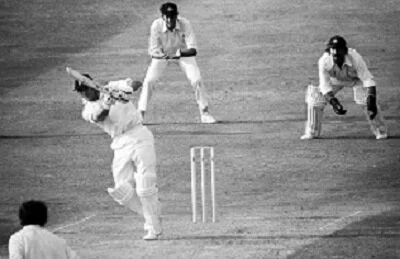
I played a bit of cricket myself at school — indeed, was captain of the Second Eleven at one time, though it is fair to add that the school only had two elevens. My team always consisted of recruits from younger age groups who weren’t good enough to get into their own teams. It was like Falstaff’s army. However, I watched a great deal more cricket than I played, on our black and white TV when the BBC showed every ball. Then, in the late ‘fifties and ‘sixties, cricket was, in summer, a national obsession. Housewives would come back from the shops with a bag of groceries and the latest Test score, Cowdrey’s fifty, Laker’s sixth wicket. But my golden cricketing moment comes from a slightly later era. It has to be the glorious on-drive which brought up Geoffrey Boycott’s hundredth hundred, fittingly at Headingley against the Aussies, in 1977. Boycott was a batsman who aroused, and still does arouse, very mixed feelings, from distaste at his curmudgeonly criticism of younger players, not to mention the unsavoury aspects of his private life, to adulation for his dedicated application as a run compiler and one of England’s best ever openers. I have always found his reading of the game on TMS most acute, especially in his analysis of the psychological aspects. Looking at film of his batting forty-odd years ago, you cannot help but be impressed by the poise, the fluency and grace of his technique. He never went in for heavy bats. Everything was in the shot selection and the timing. He is a lover of the ballet, apparently.
Here he is, the second picture showing him getting his 100th 100 at Headingley.
*
When I lived in Yorkshire, every other Saturday I would drive to Bradford, the boys in the back, to watch Bradford City. One day we set off earlier than usual. i wanted to see the house where I was born. As Valley Parade came into view, I veered off right to the district of Eccleshill to find a street called Mount Avenue. It proved to be a steep hill of terrace houses and my birthplace was at the bottom, holding the rest up, as it were. The men in their shalwar-kameez and the women in their burkas were of Pakistani origin whose families had come over in the 50’s and 60’s to work in the mills, and latterly to drive our taxis and run our corner shops. I stopped for a moment at the bottom house and remembered my mother’s story of how in the heavy winter of 1947 my father had to dig a tunnel through the snow for the midwife to get in. Then I turned away…it was time to go to the match.
You may or may not know that the FA Cup — the actual trophy presented to the winner of the competition each year — was made in Bradford. It was designed by the jewelry firm of Fattorini and Sons and hallmarked in Sheffield in 1911.
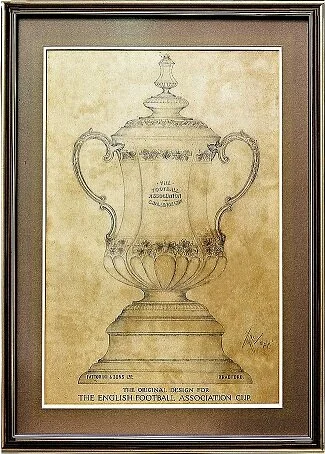
Fattorini’s design for the FA Cup
By a remarkable coincidence that was the one and only year that Bradford won the cup. The final, against Newcastle United, went to a replay after a 0 - 0 draw and the Bradford captain, Jimmy Speirs, headed in the only goal of the match.
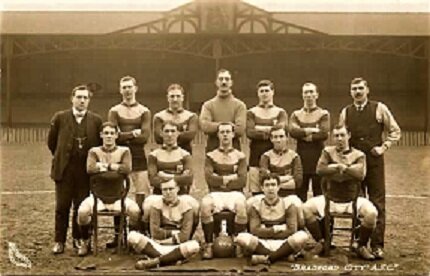
Bradford City’s winning FA Cup team, 1911
Since those days the fortunes of Bradford City have swung to and fro with great volatility. We did spend two heady years in the Premiership, 1999 - 2001, inviting such teams as Man. Utd , Arsenal, Spurs and Chelsea to Valley Parade. We travelled to famous grounds like Anfield, St. James’s Park and Goodison. My clearest memory of those exciting seasons is of a home match against Manchester United. They had won a corner and David Beckham was to take it. Paul Scholes was lurking unmarked well outside the penalty area. Beckham curled the ball in for Scholes to smite a ferocious volley into the back of the net.
Since then the team has moved in a generally downward direction and now wallows near the bottom of League Two. A recent newspaper article declared that if Bradford got relegated it would be the first team ever to have been in the top division, then to drop out of the Football League. A sorry thought, but Bradford’s result is still the first I look for on a Saturday afternoon even though I now live two hundred miles away.
*
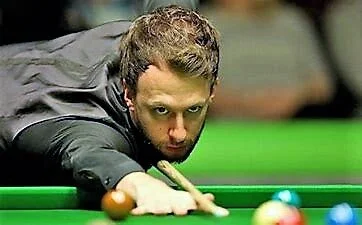
Perhaps the most telegenic of sports is snooker. All is focussed on that 12’ x 6’ of green baize. The camera has no need to roam. When the three major contests come round — the UK, the Masters and the World Championship — I allow myself to watch daytime TV. Some people find the game unbelievably tedious, just knocking balls around a table for hours on end, frame after endless frame. Others, like me, find it utterly engrossing. Each frame is different: due to the nature of spheres and their contacts and collisions you never quite know how the balls will end up, and after each shot a new challenge arises. On a couple of occasions I have been confronted with a snooker table. The TV, however excellent a viewing medium, gives you no real idea of the size of the thing. Only when you stand beside one do you realise the distances involved. And the balls, their size and weight…. I used to pass many happy hours with my mates in the local pub (remember?) playing pool for as long as our 50p’s lasted. After a bit of practice you could reach a moderate standard — the scale of the game was manageable. But the first time I tried to hit a snooker cue ball I realised how large and heavy it was. The result was woeful. I couldn’t hit it in a straight line and it never reached the object ball. When eventually I managed to make contact, the red dribbled off to rest meekly on the side cushion a good two feet from the pot. So how someone like Judd Trump can crack the ball into the pot and then make the white ping round the table off three cushions and end up perfectly placed for the next shot is beyond me. Like any other good game, snooker generates its own drama. The potting and break-building can be delicious to watch, but the cat-and-mouse of a period of safety play can be most absorbing too. I think that in no other game is the psychological aspect so telling: the silence before each shot (even without lockdown conditions), the complete focus required, the decision making, the sitting helplessly in your chair whilst your opponent makes a century, and the way you handle the intense pressure. Because of these variables the outcome of a match is never predictable. With Bradford still vaguely in mind, I recall the World Championship of 1986 when Joe Johnson, a native of Bradford (and a supporter of the Bantams!) and a rank outsider, beat Steve Davis 18 - 12 to lift the trophy. He faded from the top flight after that and now runs a snooker club and coaches young players.
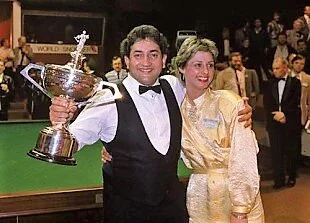
Joe Johnson with wife and trophy after winning the 1986 World Championship
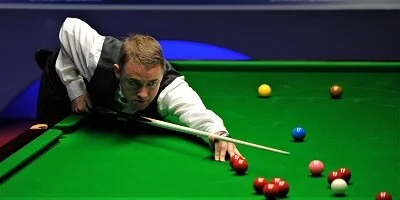
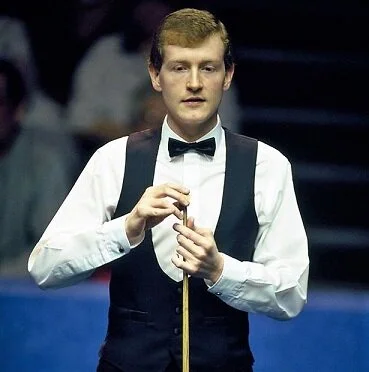
I have grown up watching the likes of Ray Reardon, Terry Griffiths, Alex Higgins and Jimmy White, then Steve Davis and Stephen Hendry. It’s wonderful to see seasoned campaigners like John Higgins and Mark Williams still holding their own in major competitions as a new generation of stars emerges, superb players like Neil Robertson and Judd Trump. I am already savouring the prospect of the World Championship in April. Will there be an audience, I wonder.
Judd Trump, the reigning World Champion, and Stephen Hendry and Steve Davis in their younger days….
*
The only sport I have been involved in in any sustained way was running. I started running almost as a necessity. When I joined the staff at a boys’ grammar school in Yorkshire I was expected to participate in Games teaching. In summer I was happy to take on some cricket, coaching the U14’s, but my total ignorance of rugby meant that in winter I had to ‘do’ cross-country, along with the skinny, uncoordinated inadequates who failed to make the rugby squads. The advice from the Head of Games was simply to keep well out of sight for the afternoon. Other than that I could do what I wanted. Soon a pattern emerged where I would devise a course round the local paths and farm tracks for the boys to attempt. I felt that I could not just leave them to their own devices for fear they might never come back, so I joined them, cajoling and goading their sorry frames through the wet and the mud till they arrived at a distant playing field, well out of sight of the rugby pitches, where I’d had the foresight to secrete a football. We concluded the session, therefore, with a somewhat chaotic kickabout which did, however, encourage a few glimmers of enthusiasm from boys who would rather be in the library or the science lab.
From these uncertain beginnings I began to quite enjoy running. I gave up smoking for a start and before long was going out for lengthy runs on my own. Then I started entering races, road races at first. At the time, Wakefield had both a 10k run and a half-marathon which I entered. The latter race also had a junior event which my sons, James and Andrew, entered. Here they are:
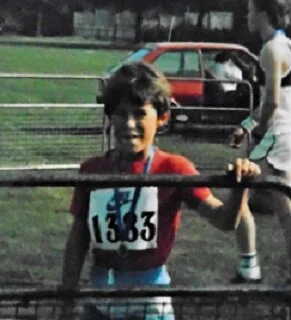
James, just finished, with his medal
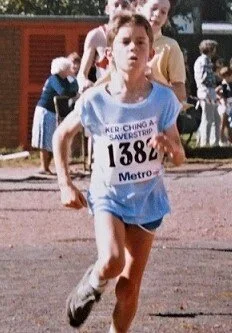
Andrew, just about there
Then I discovered fell running. A drive over to the Pennines or down to Derbyshire could get you to a fell race most weekends. Though it is the most gruelling form of running, the climb, the negotiation of rocks and streams, the feeling of release on the descent and just the elation of running in nature, wild almost, made me an addict.
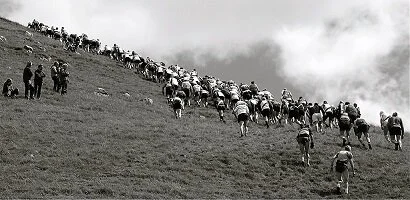
The Buckden Pike Fell Race which I entered a few times. I might even be in that picture somewhere near the back!
And then there was the social gathering. Most race organisers had the good sense to have the start and finish at a pub. Here we would gather after the race for much needed refreshment — the famed Lakeland fell runner, Joss Naylor, recommended Guinness — and the awarding of prizes. Sometimes items were donated by local sponsors. The only prize I ever received was a box of eggs from a nearby farm, for being the second Over 50. The older you got the better chance you had of a prize.
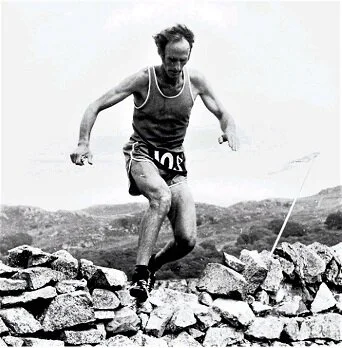
Joss Naylor
*
That was, of course, a digression. Fell running can hardly be called a spectator sport and I’ve never known it be televised so it cannot count as one of my lockdown sports. I suppose there are still many wives and partners who sigh with despair when their menfolk get engrossed in sport. Fortunate indeed is the man whose partner enjoys sport. Happily, more and more women are getting involved in sport and their activities are getting much more media exposure now. I am heartened when my granddaughter says she is going off to play football with her friend.
Enough for now to be grateful to the organisers of sport for making so much of it happen at the moment, even if it is to empty arenas. I am not a great watcher of TV drama; for me the state of play in a Test Match, an FA Cup tie or a snooker final is drama enough. And it’s real, I reflect, even when it is happening five and a half thousand miles away in the sunny heat of Sri Lanka. With that thought I snuggle under the blankets for a few more overs until it’s time to get up and make a cup of tea.
As I post this, England have won the Test Match, Manchester United beat Liverpool 3-2, and the death toll has now exceeded 100,000.