A Sense of Place (1)
The car park at the end of the long drive is closed owing to the pandemic. This means that I have to get to my ‘place’ somewhat obliquely by an overgrown path through a little trod belt of woodland. After half an hour of birdsong and walking I pass between banks of flaming gorse bushes and emerge onto my familiar track and continue on my way.
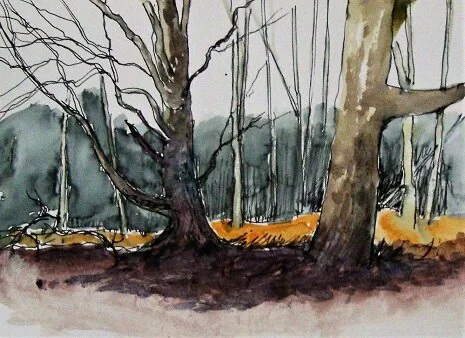
Through the Wood
*
A sense of place for me often starts with a map. From an early age I’ve been fascinated by maps, especially the large-scale OS maps of wide open countryside where I would read the pale brown contour lines, the green patches of woodland and the thin blue meanders of watercourses and imagine that I was there. Amusingly, it is a running joke in my family that when we go for a walk we often end up clambering over fences or wading through waist high nettles. ‘Oh, here we go, lost again,’ they grumble. I reply, to deaf ears, of course, that I am not lost. I point to the map…look, we are here, but this path has disappeared, that field has been ploughed up, someone’s put this barbed wire up. It happens. We are never ‘lost’ for long, anyway. Maps show you where you are in physical space, give you a sense of place if only a two-dimensional one.
*
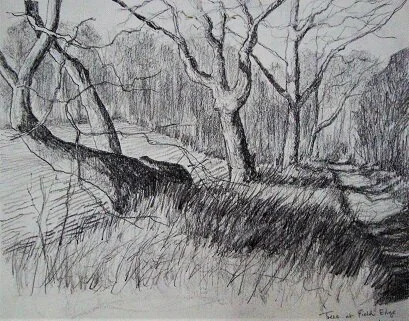
A pencil drawing
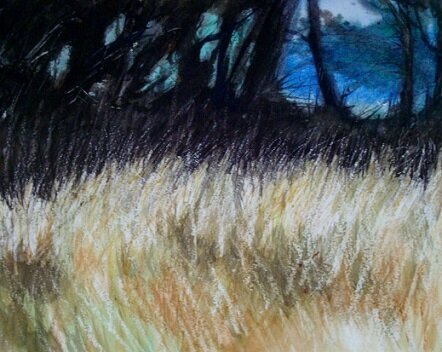
The track is lined on one side by beech trees, strangely serpentine, bent by wind and weather into sinuous growth.
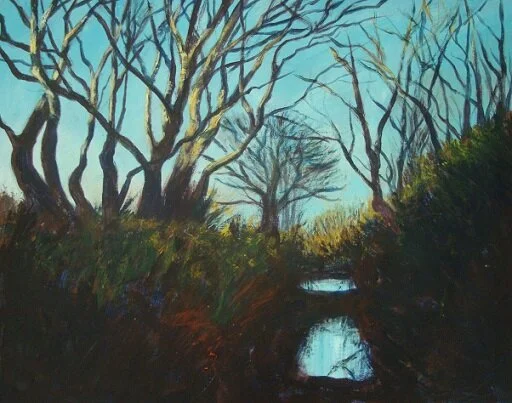
Beech Trees by the Track….an acrylic painting
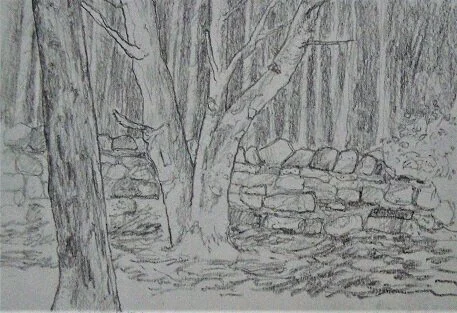
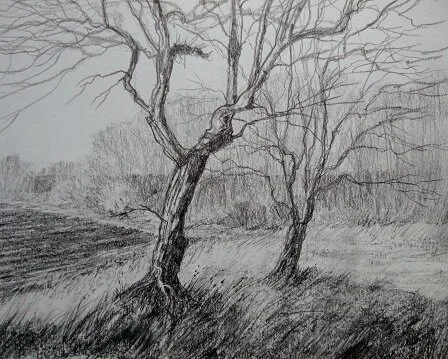
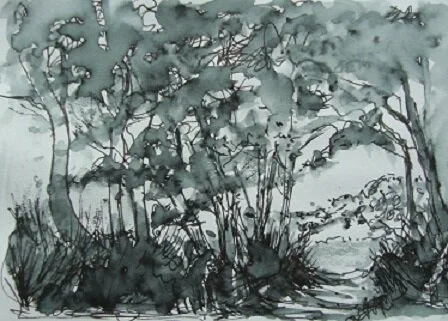
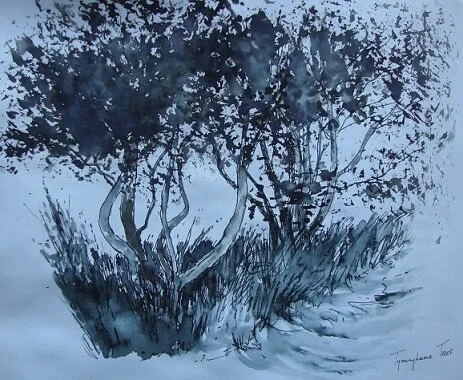
Further on and a field, fresh with young corn, stretches away to a stand of pines beyond. A few old thorn trees twist up from the ditch at the edge of the field. I have a great attachment to trees, our largest vegetables. I lean on them, perch on their lowest branches and have been known to hug them. I also like drawing them.
*
This is the land of what was once the estate of the Earls of Haddington, centred on Tyninghame House. Without the ‘e’, Tyninghame could be a little village in Norfolk, a very Anglian name, unlike Dunbar just up the road: Dinn barr, Gaelic for ‘the fort on the summit’. Like many place names in this part of lowland Scotland — Linton, Athelstaneford, Whittinghame, Stenton — it testifies to the settlement of the English here with the expansion of Northumbria in the 7th Century. From early times the place has had ecclesiastical connections. The 8th Century saint, Baldred, who had spent time at Lindisfarne, is supposed to have had a cell here and has left his name to numerous local features: the rocky formations of St. Baldred’s Cradle, his ‘Boat’, a little inlet just up the coast, the church in North Berwick and the site of the ruined church in the grounds of Tyninghame House. Later the place came under the authority of the Church in Durham, then St. Andrews. Ironically, there is no church in Tyninghame now.
*
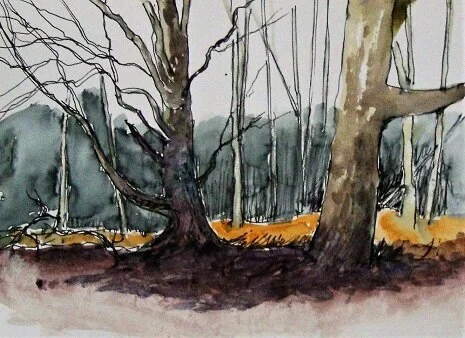
Of course, knowing where you are on a map does not mean you know where you are in any other sense. In fact I have an idea that it is somehow in inverse proportion to knowing where you are psychologically, emotionally, even morally. Reading maps, like listening to the Shipping Forecast, secures our sense of physical location which offsets, perhaps, the tidal vagaries of our personality and temperament. Following tracks and paths through the woods and along the shore is not only a pursuit of the manifestations of the natural world but also a quest for our own identity, our place in the wilderness.
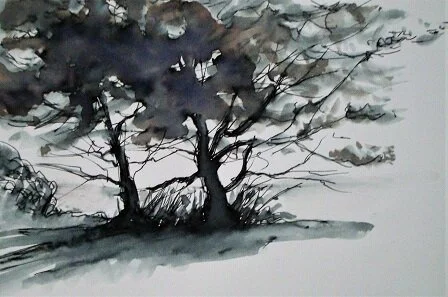
A drawing in ink and water
*
The track now crosses a stringy little stream reflecting shards of sky. It then descends to a small marsh which in Spring is alight with the neon glow of yellow irises. And across the way, hidden behind the drystone wall, is a tiny lake embedded amongst old fallen tree trunks and bounded by a low rocky cliff. It is fringed with rushes and weed. In summer the clifftop grasses will be alive with butterflies and moths — fritillaries, blues, orange-tips, burnet moths. It is a secluded spot, a place left to its own devices.
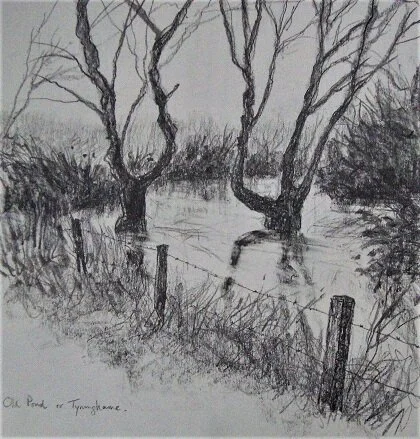
The Marsh, a pencil drawing
Back to the track and it is time to look over the wall and greet the horses, three of them quietly grazing in the meadow — a handsome chestnut with a black mane, and a small short-haired pony with a head rather like an ass’s. A girl I once saw tending to them told me that it was a Skyrian horse, a Greek breed often used as pack animals. It had been adopted from a rescue centre. And then, the beautiful white horse with the flowing mane. I call him Shadowfax, though I think Gandalf would have trouble getting this placid steed to whisk him away on his heroic mission on the wings of the wind….
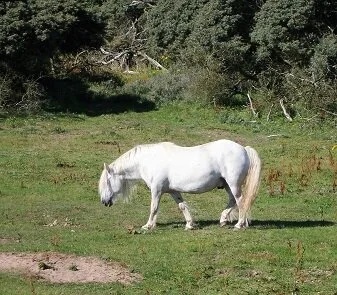
Shadowfax
….and I can hear now what sounds like the wings of the wind. It is the eternal breathing of the sea. I scramble up a sandy path through the dunes, themselves a silver sea, undulating waves of marram grass. I emerge at the top of the ridge of dunes and take in the wide sweep of the bay, the rocky headlands and the sea itself, the ultimate image of the ever evolving flux of the universe.
Another way into a sense of place is through time, deep time, and the knowledge that as I ramble along these pathways I am the slightest of footprints on the surface. Before me, the endless motion of the sea — the tension and release, the advance and retreat of its breaking waves, the huge heartbeat of the tides. Beneath me, metres, kilometres deep, layer upon layer of rock upon which the landscape of dunes, hills, woods and streams are but a thin crust.
Along the shore towards Bathan’s Strand is a tall cliff where the depths of the earth have erupted and broken through the soft layers above in a volcanic burst and solidified into hard rock.
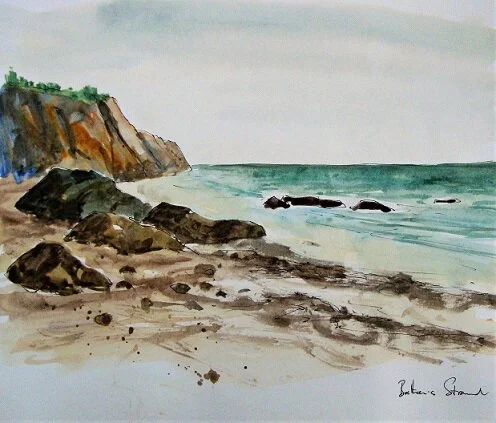
The Cliff
When the tide is in you have to clamber up, over and round the back of the crag to regain the shore. Today, though, the tide is well out so I walk round the base of the rocks to find….my seat! At the foot of the cliff is a perfectly shaped stone where I like to sit. Above the hushed rhythm of the sea is a descant of bird cry — redshanks, oystercatchers and the lone curlew. To the east is the promontory of Whitberry Point and, below, sliding in and out of the tides, lie slabs of smooth, flat sedimentary rock, fanning out like a hand of cards, each layer etched and bitten by the sea. I wonder how many thousands of years dwell within each slice. And me, a tiny molecule of peculiar human consciousness sitting fleetingly on my stone seat, observing.
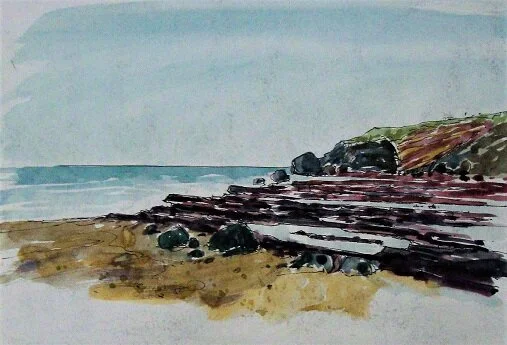
The Screeds of Rock
I rouse myself and continue round the cliff path till I come to St. Baldred’s Cradle at the northern tip of the point. This formation is a crevice incised in the tall columns of basalt by the sea, where the waves surge wildly or lap gently according to the weather. I look out to sea from the edge of the rocky headland…..a black-backed gull skims across the waves, a couple of little fishing boats bob back to the harbour in Dunbar.
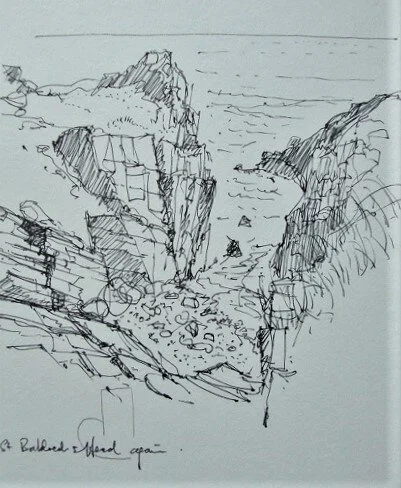
A pen sketch of St. Baldred’s Cradle
It is time to turn and go, to take the way back, the journey to be resumed next time.
Beyond
Beyond the windblown edge
frayed with shivering grasses,
beyond the black wing flapping
in the corner of my eye,
beyond the pane of light
fractured with the coldest blue…..
the grey steel, the keen blade,
the blind angel rising
and the voice of a stranger.
The path behind me leaves no trace
and the way ahead is empty
as my shadow clings to my feet
where I stand at noon,
eyes squinting at the horizon
and the whiteness beyond.