Cricket, lovely cricket.....
So goes the jaunty calypso celebrating a West Indies victory over England. Unfortunately, as I write this England have just lost the first match against them in this summer’s Test Match series. But I am not too dejected. It was a good game which hung in the balance for much of the last day. And I rejoice that cricket is actually being played again after a long period of ‘lockdown’, and that I can listen to it on my little transistor radio, which, some of you may recall, was my Desert Island ‘luxury’ a few weeks ago.
For Test Match Special is back, an English institution to rival the Shipping Forecast! Once more I can tune into the voices of Jonathan Agnew, Simon Mann, Alison Mitchell et al. Sir Geoffrey has, it seems, hung up his commentating boots but, even so, ‘Aggers’ could not resist telling another story about him which, if you’ll forgive me, I’ll retell. It is the custom at the lunch interval for Agnew to interview a special guest. On this occasion it was to be the rock legend, Alice Cooper. “You’ll never guess who I’m interviewing today, Geoffrey,” he said. “Nope,” replied Boycatt, Agnew’s co-commentator at the time. “It’s Alice Cooper,” said Aggers, gesturing to the back of the commentary box, where the rock star and his wife had just arrived. This evidently meant little to Geoffrey who swivelled round. “Hello, Alice, nice to meet you luv,” and promptly shook the wife’s hand.
*
I don’t remember ever being taught cricket, but my father must have had something to do with it. In his youth he had played for Jer Lane Cricket Club in the Bradford League, where many fine Yorkshire cricketers were tried and tested. I’m not sure how my dad would have got on with the dusky skinned members of today’s team though. When we moved down to Buckinghamshire, to a small village in the Chilterns, he continued to play for the local team. My first memory of the game was being stationed on the boundary with other small boys to retrieve balls struck into the gorse bushes.
Later, after another move, when I was at Junior School, at playtimes in the summer months my mates and I would rush out to the school field. Down one side was a row of conveniently placed fir trees with straight, slender trunks, ideal wickets for several games of cricket to proceed. At around nine years of age I fancied myself as a demon fast bowler and charged in, sleeves rolled up like Freddie Trueman, and hurled my missile down with what I thought was fearsome speed. We didn’t have proper cricket balls, of course, but tennis balls or rubber ones did the trick. My first bat was hewn out of a bit of planking by my father. I was very proud of it.

But gone, it seems, are the days when boys would go and play cricket in the local fields and recreation grounds. Only private schools teach cricket seriously now, and children have found other things to do. Then, however, it was just what we did — in winter we played football and in summer we played cricket. It was part of the national consciousness. I remember my mother coming back from the shops with a bag of vegetables and the cricket score. “There we are….potatoes, cabbage, carrots…and Cowdrey’s just got his 50.”

*
By the time I got to secondary school we had a telly, a black and white one, and you could watch cricket all day on the BBC. Many hours of the summer holidays were spent thus sofa bound. Although I continued to play cricket with my friends at weekends and on summer evenings, my prowess did not particularly impress the school games teachers. The trouble was that I developed a healthy fear of the hard ball. In one games lesson when I was about thirteen, we were in the nets poking around in a rather desultory fashion when the cricket master, a brutal man by the name of Lander, summoned a couple of fast bowlers from the First XI to come over and test our metal. “ Now then, you shower, these men are going to bowl their fastest! I’ve told them to try and knock your blocks off!” Men! We hardly had time to adjust our pads before the onslaught began. Although my head remained intact, other areas of my anatomy received more than enough excruciating blows that afternoon to make me reappraise my approach to the game.
What I clearly lacked in physical courage I made up for in a fertile imagination. I used to practise in our back garden. There was a lean-to outhouse comprising a coal shed and a privy. Its sloping roof provided a perfect means of practice. I would toss the ball — a tennis ball, of course — against the house wall then watch it rebound down the sloping tiles of the lean-to and shoot off the edge. I would dive this way and that, pulling off spectacular slip catches or with my bat execute perfect defensive shots and drives. I did my best to resist the cross-batted shots though. A hearty pull or hook would end up several gardens away on my left; a crashing square-cut would bury itself deep in the rose bed to my right.

Something of my abilities must have attracted attention though, because when I was in the sixth form I was, somehow or other, made captain of the Second XI. This is not as impressive as it sounds since the school only had two elevens. It was often difficult to recruit players for the weekend match and I often had to raid the younger squads for boys who had failed to get into their first teams. Once I begged a lad from the U15’s to play for us. He had been temporarily laid off due to an eye infection, but reluctantly he agreed and turned up dutifully on the day with eye-patch firmly in place. I felt a bit like Falstaff mustering his rag-tag troop before the Battle of Shrewsbury. We did not enjoy great success as a team. I was not skilled enough to lead by example. My fast bowing had given way to what I imagined was a wily brand of slow spin bowling. Sadly it often didn’t spin at all — it was just slow, easy meat for any half-decent batsman to loft back over my head for a boundary. And my batting consisted mainly of tentative pokes and nudges. My captaincy, therefore, was founded on amiable encouragement from the field and a determination that each of my pressed men should play a part, even the lad with the eye-patch.
The First XI was a race apart, a race of gods. Every year, towards the end of the Summer Term, the whole school would wander up to the playing field to watch the Staff v 1st XI cricket match. Some of our teachers were decent players; the brutal Mr Lander had played for the Minor Counties, and a history teacher, Mr Pitt, built like a bull-terrier, could deliver a terrific clout to the ball. But they always lost to the supremely honed skills of the First Team. I remember a youth, Curtis, I think, striking majestic boundaries off the staff attack.. I regarded him wistfully, sitting in the long grass at the edge of the field.

*
When I became a teacher myself it was at a traditional boys’ Grammar School, where the masters were expected to contribute something towards Games. It was a school where rugby was sacred. Boys who showed talent were from an early age specially reared, as it were, behind closed doors, to emerge later, rather like Napoleon’s pigs in ‘Animal Farm’, as muscle-bound totems of superiority, the school’s enforcers. I had never played rugby and hadn’t a clue about the game. In the winter months, therefore, I was charged with taking Cross-Country. In practice this meant leading off the rugby rejects, the infirm and otherwise inadequate on a lengthy trek around the neighbouring farmland with instructions not to be seen again on the sports field, where of course the rugby boys were undergoing the rigours of their training regime, till ten minutes before hometime.
In Summer, however, I was very happy to take a cricket team and spent many years with the Under 14’s. I think I was slightly more successful as a coach than a player. Perhaps there is something in the adage, ‘Those who can, do. Those who can’t, teach.’ But I was happy to teach and enjoyed umpiring the inter-school matches. One year my team won the Lords Taverners Trophy, a most satisfying achievement. I hope Mr Lander was watching from somewhere above….or below.

*
I did continue to play a bit of cricket, however, in the Staff Team. As at my old school there was an annual Staff v Boys match but here it was the 2nd XI we played. We still lost. But we also played staff teams from other schools. I played regularly and I think my loyalty was prized more than my ability. Only two moments of success remain in my mind. I was considered more of a bowler than a batsman, justly so — I think my batting average was about seven. But in one staff match I made my highest ever score, 45. It must be said that I took advantage of some pretty feeble bowling and inept umpiring. I’m sure I was out lbw on more than one occasion but the finger never went up. But I remember one particular shot: the bowler lobbed up an innocuous full-toss and I gave it a huge wallop. The ball sailed up and over some trees into the Headmaster’s garden. We listened for the sound of tinkling glass but thankfully none came. The other occasion was a catch. An accomplished batsman for the opposition was at the crease and I was posted near the boundary at deep square leg. I saw him set himself up and smite a short pitched ball high in the air in my direction. I back-pedalled furiously, convinced the ball would sail over my head for six. I wasn’t even looking at the ball when I thrust my arm in the air. To my surprise there was the ball nestling in the palm of my hand. I didn’t even feel it go in.
The rarity of such moments only underlines my mediocrity as a player, but I love the game as much as ever, especially in its Test Match form. Here is a game that can go on for five days, unfolding like a drama: the individual players, their different styles and characters, the intense moment of each delivery, the array of shots, the fielding….and all this set against the evolving plot of the match as a whole, the balance always tilting this way and that. Now I am happy to become endlessly absorbed and fascinated by the game as it comes across the airwaves to my transistor radio by means of Test Match Special.

*
It was perhaps a symbolic moment when I gave away my surviving cricket bat. I was living in Wakefield at the time in what could be called an ethnic quarter. Unlike their white peers, the Pakistani boys were very enthusiastic about cricket and played down the back streets and alleyways. One day I was doing a bit of weeding in my small garden when a scruffy tennis-ball landed beside me. I picked it up and opened my back gate to see a little group of local boys peering up at me, one holding a badly battered bat. I recalled my first homemade bat. Then I remembered that I had a pretty decent Slazenger bat in my shed which had lain unused for years. I gave it to them, along with the tennis ball, and they ran away delightedly.
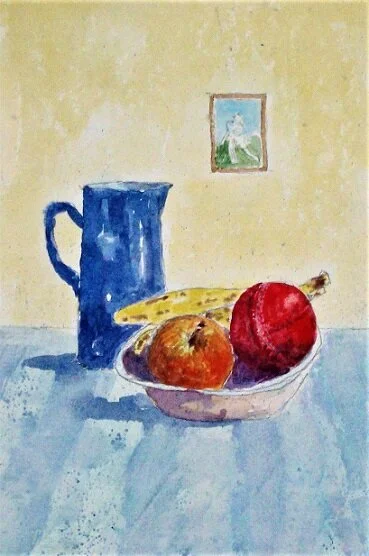
Still Life with Cricket Ball