Moments
Another time, another place. A street of red brick terrace houses. Most of my neighbours came over from the Mirpur region of Pakistan three generations ago to work in our mills and factories. Now they drive our taxis, run take-aways and keep our corner shops. Two doors down, the Victorian chapel is now a mosque. I watch the men in their salwar qamis file in for Friday prayers and the children trotting in after school, freshly changed, with their Korans tucked under their arms. They are a quiet, peaceable people. Sometimes the street is lit up by a wedding the colour of a summer flower-bed, with singing and the beating of drums. The young boys play cricket along the back-street ginnels.
Cockerel
Down this back street of
drains and curry smells
the cockerel
kept in a packing-case
in a yard with an old bicycle
and a pot of coriander
breaking the day
with his can-opener craw
his red-rusty doodle-do
‘Get up and get on with it!’
And we do, we do.
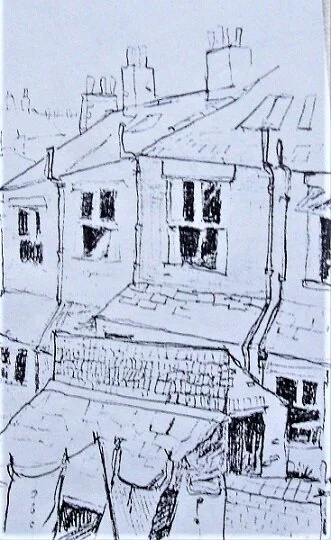
The Street
A moment, plucked from the tread of time. We remember moments, not days or months. I entered this poem, along with another one, for a competition based in the Channel Islands. It was for short poems to be displayed on the local public transport. They got into the final selection — perhaps not many people entered — and thus I had the satisfaction that bus passengers could look at my poems whilst trundling around the narrow lanes of Guernsey. Here is the other one.
That Feeling
Sometimes it’s like
moving round a spacious house
all glass and angles
cool floorboards
the furniture minimal
— a low table
that chair like a zed —
and the quiet invasion of light
from the wide garden
me barefoot
in loose clothing
uncertain of the time of day
or the door to open next.
As to what ‘that feeling’ is, your guess is as good as mine. Sometimes feelings can be enigmatic and only realised in images. Like the other poem it captures a moment in time, which is what poems and pictures do, in a sort of rescue act to save sights and sounds, thoughts and feelings from oblivion. Here is another poem from my back street life.
Aubade
The tree in my town garden
breaks from its shadow.
Birdsong nibbles at the dawn.
Night is pushing the day ajar
and the sun waits in the corridor.
The glass towers are stirring like hives.
Steam from a heating duct
releases a young ghost.
Waves of early traffic break
on a brightening shore.
And the morning lies before me like a beach.
I will search for what the tide brings in.
I will leave fresh footprints in it.
Someone setting out into the awakening world to catch something of it before life is swept away. The passing of time can be the cause of melancholy resignation before the inevitabilities of ageing, loss and death. Seneca the Stoic urges us to make the most of the present, ‘to gentle the passing of time’s precipitous flight’. And his exhortation to use well what time we have is a worthy one, for, as he says, it is often the case that ‘those who have lived a long life have lived so little.’
The passing of time is also the cause of much stress. People commonly complain that they haven’t enough time when a hard look at the history of working hours and holidays shows that we have more time than ever, even if it doesn’t seem so. Rowan Williams in his book, ‘The Way of St. Benedict’, says we live in an age of ‘time famine’, by which he means a dearth of time when we do not feel driven to cram it with activity…a time to be still, to be in the moment. The pressures of advertising, increasingly directed at you personally through algorithms shaped by your online activity, government health warnings, the insidious snares of social media all drive us to keep up with the latest diktats about exercise, diet, saving the planet, keeping safe on the internet, as well as to respond instantly to the latest ping on the smartphone. Moments disappear beneath the flood of trends and obligations we feel compelled to keep up with. Sometimes we are so preoccupied with getting through the wood that we don’t notice the beauty of the tree.

Birch Tree
Living as we mostly do in linear time, clock time, it is clear that time only goes in one direction, ‘time’s precipitous flight’, no matter how hard we try to slow it down or stop it. And if you drop a plate on the floor and break it, there is no way, except by running a film backwards, that you can watch it reassemble itself. Though sometimes it’s fun to try.. I am sitting in a cafe with a pot of tea and something from the cake counter.
On the table a white teapot
and a demure milk-jug,
my cup nestling in its saucer
and a plate bearing a small apple tart.
I take care how I position these items
on the black surface
and contemplate the arrangement
like a chess player.
A history has led to this moment…..
the tea reversing up its spout,
me walking backwards out the door,
you swallowing a laugh
as anger dwindles to a coal,
the letter I’m holding unopened.
Tears squeeze into the corner of an eye
as hands release their grip,
that babbling confession
like a foreign tongue ending in silence,
before all those landscapes roaring in retreat,
until bones grow soft again
and slip into the unfathomable….
this moment which will find
me deftly sipping tea
and leave an apple tart incised
with a bite that won’t be taken back.
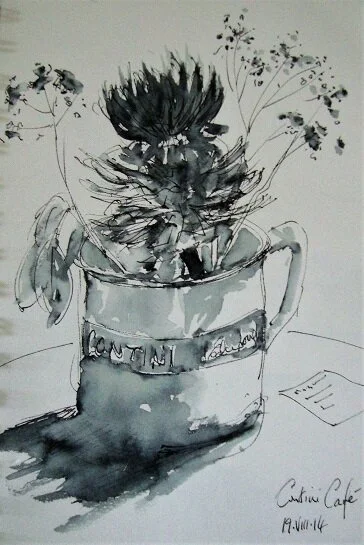
In the Cafe
The ubiquitous mantra of sages and holy men through the ages, as well as the behavioural therapists and mindfulness gurus of today, is to live in the present, to dwell in the moment. If you truly lived in the present, they say, you would achieve peace, relieve your anxieties and, as one writer avers, effectively add years to your life. I have found living in the present much easier said than done, despite several faltering attempts at meditation and mindfulness exercise. In a technical sense, of course, the present can never be found. Like Zeno’s paradox of the race you can never get to the end of because you’ve always got to cover half the distance already done however little is left, so you cannot keep splitting time up until you get to the ultimate, instant present. And no sooner has it arrived than it is gone. These are fascinating, if foolish, speculations. I like to think of the present not as a fixed point in time but more like a wave breaking. You can never tell precisely when the wave breaks — it tends to gather to a point of release, then unravels along the length of its crest before tumbling forth uniquely in various speeds and volumes. I perceive the present as a sort of flexible allowance of time rather like the unfurling of a phrase of music. Ironically, when you are ‘in the present’, you are unaware of time. The past and future, which occupy so much of out thoughts and cause so much remorse and anxiety, cease to exist. No less a figure than Goethe said, ‘Hold fast to the present…every situation, indeed, every moment, is of infinite value for it is the representative of a whole eternity.’
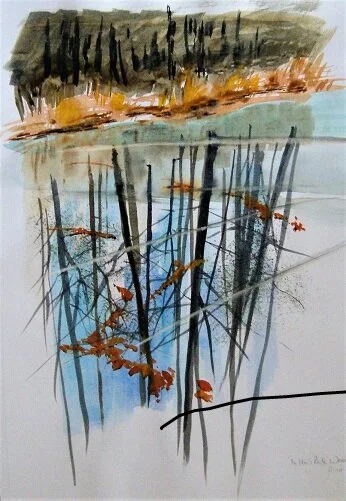
Forest Pool
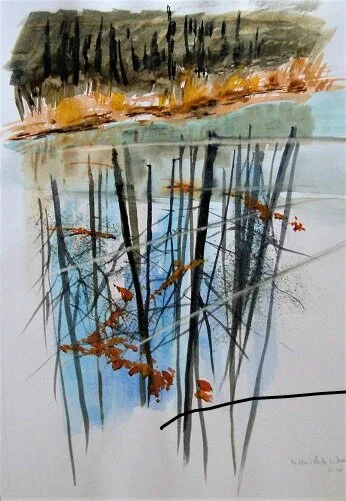
I am walking through a wood. There is a small marshy spot which after rain fills up to make a shallow pool. I stop here and observe the reflection of the trees and the floating twigs and leaves. I stand for a while enjoying the moment, a little pool of time. Beyond the pool the path skirts the edge of the wood. A wire fence and then a field with a tree or two. What is it about this ordinary view that makes me stop and want to draw it? Maybe its emptiness.
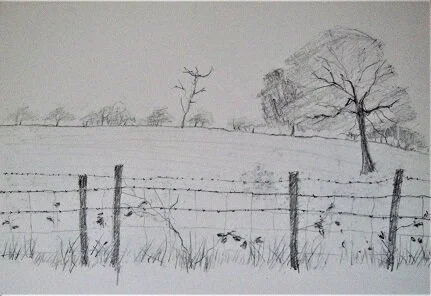
The Empty Field
Another field which had its moment was in the countryside around Ryhill, near Wakefield. I am approaching the reservoir at Wintersett towards the end of a walk. It is late afternoon in Autumn and already the dew has settled on a sea of cobwebs
The Shimmering Field
I’ve trudged through clogged lanes,
bridged culverts streaming with silt
and entered disused cuttings
deep in the debris of other nights,
the crumbling brickwork of old tunnels
daubed with desperate graffiti.
And each step tries to escape
a long and echoing past,
to imprint new territory.
So to emerge from the mired track,
cross the stile into the shimmering field
is an illumination of sorts.
Not that it is magic or mystic
nor some vision god-sent, no angel —
just the rising and dipping grass,
its shallow tents of gossamer
catching the rays of a low sun,
and me getting the angles right.
Such moments lie all around us. I suppose we just need to be on the lookout. One of my favourite sayings from ‘Winnie-the-Pooh’ is this: ‘Sometimes, if you stand on the bottom rail of a bridge and lean over to watch the river slipping slowly away beneath you, you will suddenly know all there is to be known.’ But first you have to stop and stand on the bridge.
Moments, in my experience, do not consist of abstractions but images which shake through the senses and settle into a spot of time, later to be stored in the memory’s pantry, undergoing its own peculiar process of maturation and distillation.
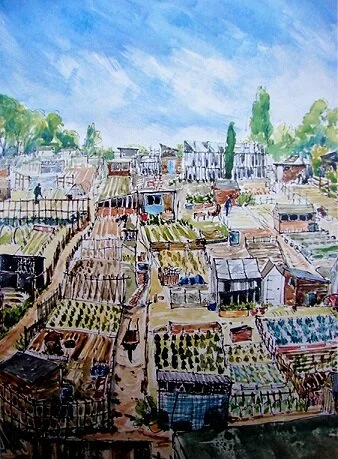
Allotments
I’m in my allotment, just up the road from my street of red brick terrace houses. The old men, many of them Serbs and Poles who settled here after the War, keep the best allotments….rows of hearty blue-green cabbages, bushes bursting with raspberries and blackcurrants. Some keep pigeons in their small wooden huts. At weekends their children and grandchildren come along and sit in the sun and play. My vegetable patch is a scraggy, undernourished affair, but I like it here.
It Was Truth
When he was younger
it was Truth he was after —
tried to catch it in Beauty,
find its tincture in Justice,
distil it in Faith and, once,
Everlasting Love.
Now he is older,
he feels the sun stroke the wooden shed,
watches a flight of doves spill
a wake of silver in the sky,
and listens to the girl in the blue dress
singing in the allotment garden.
Such moments are like coloured beads strung along the fraying thread if time.
Looking through my sketchbooks I found a rather badly executed stone rubbing.
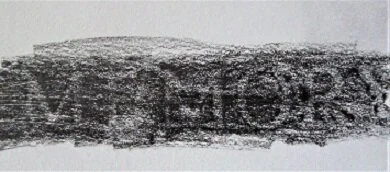
I cannot for the life of me remember where or when I did it.
*
This is my last post for the time being. I am having a blogoliday, but I hope to resume before too long.