Hedderwick
I am setting off early through familiar woods. As I start out on the sandy path, I see beyond the fence to my left, somewhat surreally, a llama staring back at me, then an ostrich strutting by. This is the local Farm Park and if it were open, which, of course, now it is not, I would no doubt also witness a miniature train tootling round its circuit, its passengers waving at me. Even Britons of mature years, it seems, derive pleasure from cramming themselves into the tiny seats of a small steam train, beaming and waving at passers by. But now all is quiet and even the animals seem to be observing their own sort of social distancing.
The tall avenues of conifers I now walk through are part of Hedderwick Plantation, fringed by the sand dunes of Belhaven Bay and the shore of the Tyne Estuary. It now forms part of the John Muir Country Park, created in 1976 in honour of the renowned naturalist and conservationist who was born up the road in Dunbar.
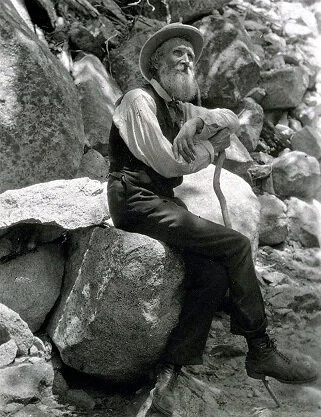
John Muir 1838 - 1914
As I walk along the tracks and paths of this popular woodland, I find it hard to imagine that eighty years ago it didn’t exist. I would be treading across a barren expanse of dunes. And I would come across squads of servicemen, English, Scots, Poles, labouring away to erect sea defences along the coast. The area had been defended in the First World War, but in 1940, with Norway occupied by the Nazis, this stretch of coast on the Firth of Forth — the main entry point to Edinburgh and Glasgow beyond — was deemed by the Scottish Command Defence Scheme to be particularly vulnerable to invasion.
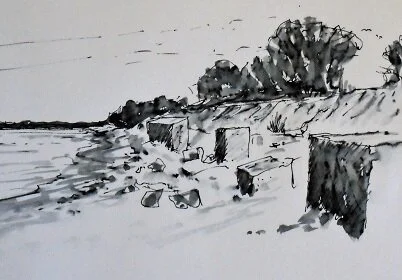
On any walk around these parts, and across the estuary at Tyninghame, you will find the remains of bunkers, pill-boxes and rows of huge concrete cubes along the shoreline. In the sandy flats of the estuary remain the embedded stumps of wooden poles positioned to deter glider landings.
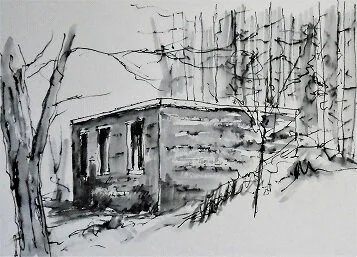
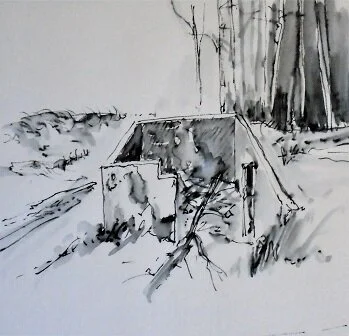
After the war the area was used as a military training ground. It was only after the army left that, in 1950, the wood was created as a commercial pinewood plantation. The name, Hedderwick, comes from a nearby farm and manor house. It seems not to be a place name as such but a family name and there are many Hedderwicks in Eastern Scotland, one branch having its seat in Dunbar in the 15th Century. There is also a suggestion that the name may have some link with the German girl’s name, Hedwig, so there is, perhaps, a tenuous Harry Potter link to these woods!
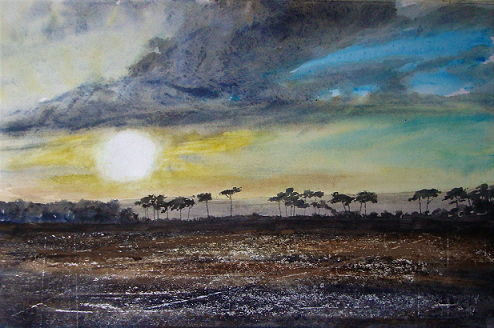
Looking across the fields to the south I see the morning sun riding above the distant Lammermuirs, casting a hazy glow over the landscape. A stand of pines is silhouetted against the light. I take a photograph which I later turn into a painting.
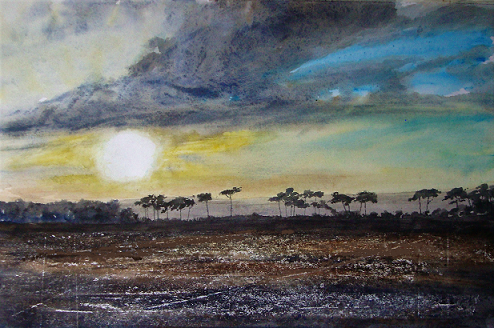
Morning Sun, Hedderwick
The picture is a watercolour on standard cartridge paper, 38 x 54cm. As with most of my landscapes and seascapes, even on thin paper like this, I spray the sheet with clean water to start with. It helps the paint to flow and run. I use relatively few colours: cadmium yellow for the sunlight, cerulean blue for the sky, which is then mixed with a little raw umber for the clouds. I rub candle wax back and forth across the fields in the foreground, then paint a mixture of raw umber, burnt sienna and darker hues picked up from my large, messy palette which I rarely clean. The foliage of the pine trees is applied with one of my favourite brushes, a scrubby old bristly thing which I drag and dab over the paper. Lastly I put in the slender trunks with a rigger.
My path now leaves the wood temporarily and crosses a small area of heathland, Young’s Knowe. In summer it is high with ferns and the short grass is embellished with wild thyme and birdsfoot trefoil. In winter, round about Christmas time, two solitary young pines are decorated with baubles and charms and goodwill messages. By whom I do not know, but it lifts the spirit. Past a row of tall pines and I arrive at the little wooden bridge over Hedderwick Burn which feeds into the estuary.
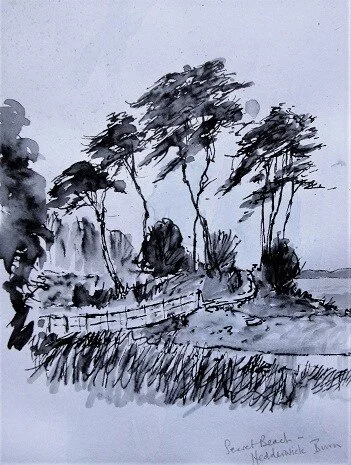
The Bridge
Erosion of the soft, sandy banks around here is severe and rapid. The shore is littered with fallen trees. Ahead of me, teetering on the brink, are a couple of magnificent Scots Pines beneath which is a bench to sit on and take in the view. How long before they lose their roothold and slide down onto the beach below, we wonder. And the seat with it, hopefully vacant at the time….
Beyond the bridge the path takes me over a common of bracken and odd, isolated trees, then joins a wide farm track flanked by a small plantation. Here I am aware that once again I am treading in the footsteps of men long dead, for this patch of land was once visited, even inhabited, by late Neolithic people. In the early 1920’s, stone artefacts were discovered: blades, axe and arrow heads, and cropmarks were discerned. Further investigations in 2018 uncovered more tools as well as pottery fragments from a later Bronze Age period. Strangely, these ancient folk, along with the soldiers who defended this coastline in the war, seem very real to me. I can see a serviceman leaning against a concrete block sharing a cigarette with his pal; I observe a dark-skinned woman crouching over a fire by a rude hut, a scraggy-haired toddler by her side, gulls crying overhead. Who is the more ghostly presence, I wonder, them or me?
Even at this wintry time of year the gorse blazes by the track and I reach the turning point of my walk. Again I look south. The sun filtering through the trees. Another picture….
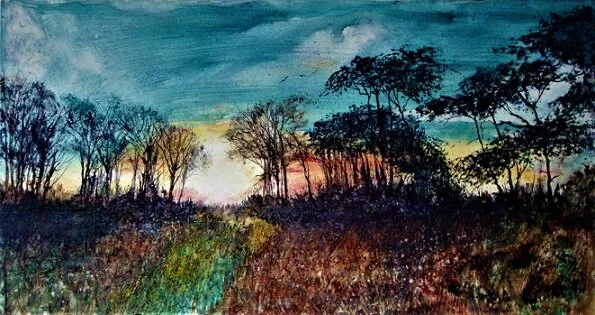
Sunglow through the Trees, Hedderwick
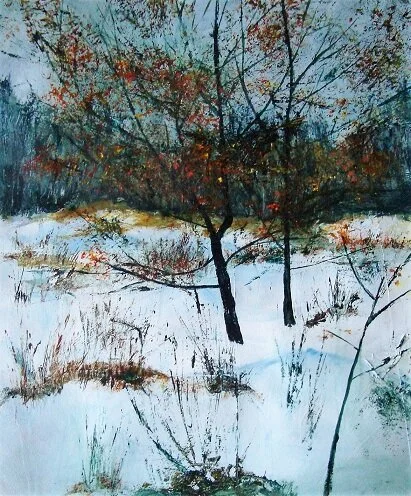
….this time on a piece of hardboard I had lying around, 42 x 78cm. Before painting I prime the board with a coat of white emulsion then a thick layer of gesso. I like using gesso as a ground for watercolour — the colours mix and merge freely and the paint is easy to lift out with either a clean brush or a rag or tissue paper. This can make for interesting textural effects, mottling and so forth. I know that there is a certain snootiness among some artists about using photographs to paint from but I don’t see what’s wrong with it. They are my photographs, after all.
At this point, I slither down a muddy bank to the shore, the shore of the wide estuary. The tide is out, the River Tyne sliding in its sinuous channel from the policies of Tyninghame House, round the head of Sandy Hirst opposite and out into the bay and the Firth. I stop by a large concrete block, part of the old sea-defences, which has slipped down the eroded bank. It makes a good perch for my flask of coffee.
My last painting, like the first, is done on cartridge paper, 38 x 45cm. and looks across the estuary to the woods of Tyninghame Links. I love the subtle light which glimmers across the sheen of water and sand flat. Again, few colours…in fact most of the paint in this picture I picked up from what was already on my palette.
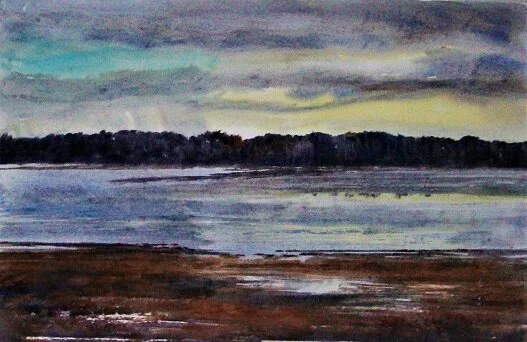
Across the Estuary
I walk back along the sandy shore, past the cliffs where in a month or so the sand martins will arrive to make their nesting-holes and dash in and out snapping up insects on the wing for their young. I pass beneath the precarious Scots Pines and cross the bridge again. Then, instead of returning through the plantation, I follow the shore around its edge, noting the eroded banks and uprooted trees along the way.
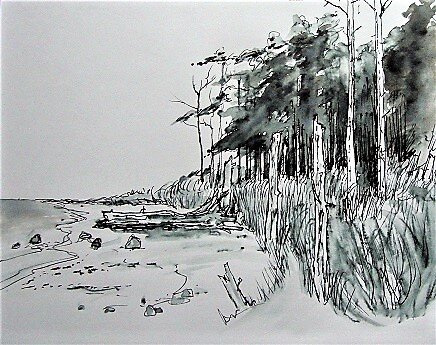

All is flux, sage Heraclitus said. Landscape, memory, identity…shifting and fusing. On this patch of ground— Hedderwick, potent with history — the past becomes present and the present is already eroding as the waves keep coming in.