The Horses
I have never had much to do with horses. When I was about six and lived on a farm, I was bundled onto the back of a huge grey mare and led up and down the broad driveway. All I recall is the rough, bristly hair against my bare legs.
There is a regular walk I do which, beyond the wood and the gleaming marsh, leads to the open fields. A scattering of horses grazes contentedly. One is a Skyrian pony, a small breed of horse native to the Greek island of Skyros. It is a protected species and this one ended up here, according to the girl I saw feeding it, through a rescue agency. It had been sorely treated.
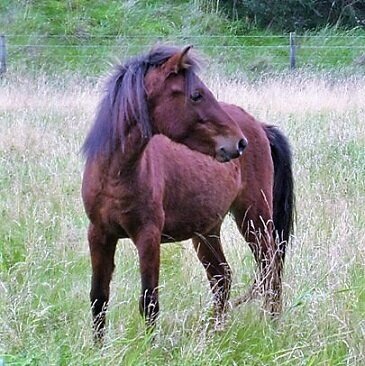
A Skyrian Horse
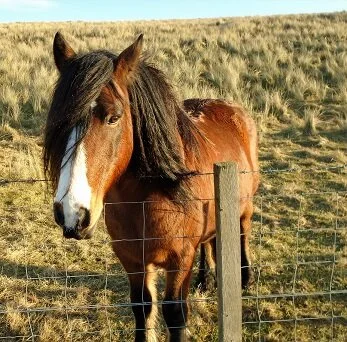
But my favourite is a large white beast I call Shadowfax, after Gandalf’s lightening steed in ‘Lord of the Rings’.
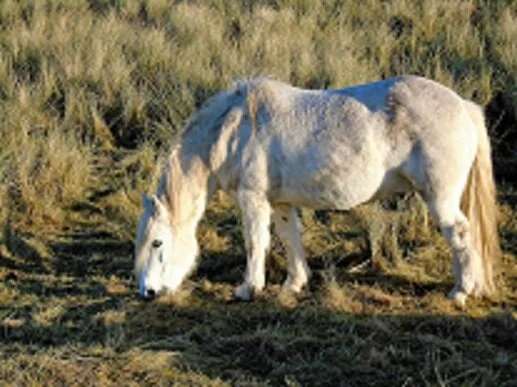
Shadowfax
I go up to the fence and try to communicate with the animal, but I get more response from its chestnut companion.
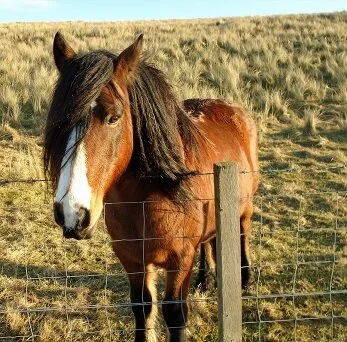
Hello
*
There are three poems about horses I especially like. The first is by Philip Larkin, ‘At Grass’. He sees some horses in the shadows, seeming to merge into the background..
The eye can hardly pick them out
From the cold shade they shelter in,
Till wind distresses tail and mane;
Then one crops grass, and moves about
— The other seeming to look on —
And stands anonymous again.
Their anonymity is contrasted with the days of glory on the racetrack..
faint afternoons
Of Cups and Stakes and Handicaps,
Whereby their names were artificed
To inlay faded, classic Junes —
Now they are left to the ‘unmolesting meadows’ and ‘gallop for what must be joy’. Then, the beautiful consolation of the ending, when the stable lads come to give them a runabout..
Only the groom, and the groom’s boy,
With bridles in the evening come.
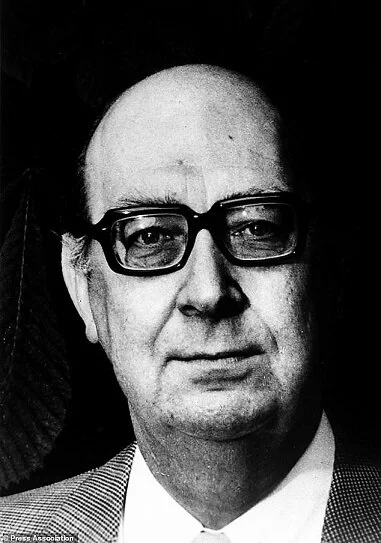
Philip Larkin 1922-1985
The next poem is ‘The Horses’ by Ted Hughes. In the early morning he climbs up through the woods to the open moor. He is in a state of some intense mental disturbance; the air is ‘evil’ and his breath leaves ‘tortuous statues in the iron light.’ Then on the skyline
…I saw the horses:
Huge in the dense grey — ten together —
Megalith still. They breathed, making no move,
With draped manes and tilted hind-hooves,
Making no sound.
These horses become an emblem of Stoic resilience and permanence against the frenzy of his own mind, ‘Stumbling in the fever of a dream’ as elemental forces erupt around him. They become embedded in his memory, so that
In the din of crowded streets, going among the years, the faces,
May I still meet my memory in so lonely a place
Between the streams and the red clouds, hearing curlews,
Hearing the horizons endure.
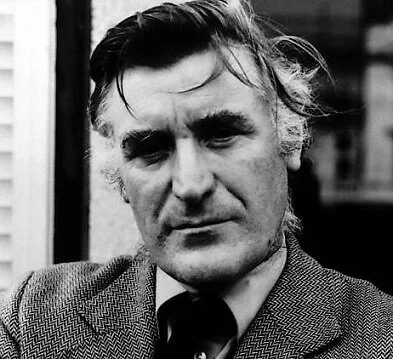
Ted Hughes 1930-1998
My favourite, though, is ‘The Horses’ by the Scottish poet, Edwin Muir. In it he envisions a post-apocalyptic world — the aftermath of a nuclear disaster— a world of fear and dreadful remorse at what humanity has done to itself, ‘That old bad world that swallowed its children quick/ At one great gulp’. Radios fail, warships sail by piled with dead bodies. Then, into this devastation, where
The tractors lie about our fields; at evening
They look like dank sea-monsters couched and waiting
the horses come:
And then, that evening
Late in the summer the strange horses came.
We heard a distant tapping on the road,
A deepening drumming
With their manes ‘like a wild wave charging’ the horses appear like mythical beasts, ‘strange to us/ As fabulous steeds set on an ancient shield’, among them ‘some half-a-dozen colts/ Dropped in the wilderness of a broken world’. He reflects that ‘We had sold our horses in our fathers’ time/ To buy new tractors.’ And now a ‘long-lost archaic companionship’ is re-established as the horses begin to pull their ploughs and bear ungrudgingly their loads. The poem ends with the poignant lines
But that free servitude still can pierce our hearts.
Our life is changed; their coming our beginning.
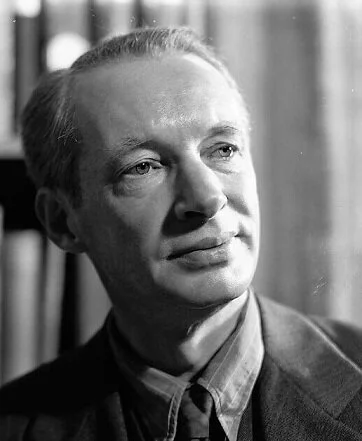
Edwin Muir 1887-1959
All wonderful poems. I urge you to read the complete texts; you can find them just by googling the titles and poets, but I probably didn’t need to tell you that.
*
I have also written a poem about horses. This is how it came about.
It is a dark winter’s day and the sky is heavy with snow. I have driven out to the edge of the South Pennine moors and parked at Langsett, by the reservoir. I start out through the conifer woods, the gleaming water below, one of a chain of reservoirs along the River Don, created to serve the masses of Rotherham and Sheffield. The path drops down to the stream itself, at this point idiosyncratically known as ‘The Porter of the Little Don River’. I cross the stone bridge and potter about among the boulders and rocks for a while. The infant river recedes up a narrow valley to its springs on Harden Moor, but my way leaves the rippling water and winds uphill onto the open moor. If I take the main track I would cross by Cut Gate and Margery Hill to the Derwent Valley where much bigger reservoirs lie in a grand three-linked chain.

Derwent Edge
But today I content myself with a circuit of little Langsett Reservoir, so I skirt the top of a wood, passing the stone ruins of old huts where I am haunted by the ghosts of the old shepherds who once hung out here. And it is beginning to snow — a few flakes at first, then a gathering in the freshening wind. I cross a small stream and take the track up to Low Moor, once an army shooting range. By the time I reach the little settlement of Upper Midhope the snow is falling thickly. A narrow footpath leads away from the cottages and I find some shelter beneath the dense foliage of a holly tree. I stand here looking out at an empty paddock opposite, which whitens in the drifting snow.
The Horses
The sky primed with a charge
of impending snow,
I found a shelter of holly
and huddled in its waxy dark.
As the first flakes drifted down,
I saw them beyond a fence,
the horses, lean shapes,
quiet under trees.
Then, pressed by the sky’s weight,
the snow surfed in,
rattled the shell of my holly cave,
spooling across the open spaces.
Till, sleek flanks trembling,
they came out, separate,
pawing the whitening ground
to face the swirling element,
then turned, tossed their lithe necks,
reared and stamped the air,
and, prancing, meant
to outspirit the dauntless weather.
Such cantering abandon to mock
the wind’s rush, such flex
of driven limbs to engage
the onset of whirling white!
What dancing nerve heralded
the skidding hooves, what primal hunch
championed each bucking leap,
I could not think.
And when the sky had spent
its load, become cold gleam again,
I saw them rein their strength,
slow to a sinuous halt.
Beguiled by the weather’s sleight
and shaken from my cove of leaves,
I left the horses silent and composed,
steaming in the dripping field.
I suppose it was the absolute ‘otherness’ of the creatures that so absorbed me as I watched them from my holly cave, their moving to different algorithms, their sharing of the elements in a way we humans can’t, quite. As the snow eased I left the horses to their own devices and found the road back across the dam to the car park.
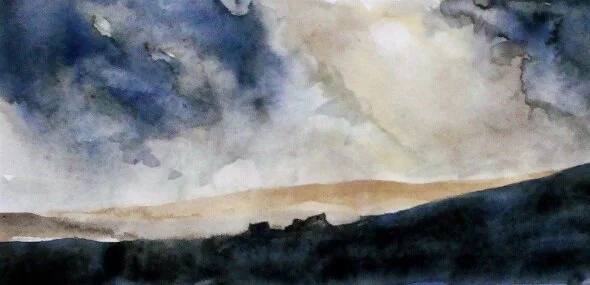
Pennine Sky