Sky Fall
When I moved north of the border I came to the sea. I’d never seen much of the sea before, and all my attention went into it — the sea and the shore and the enticements of drawing and painting they offered. But I also came to the sky. Of course, the sky, unlike the sea, is always with us but for most of the time we tend to take it for granted. In many urban settings it can be crowded out by walls of brick and concrete. But up here the sky has heft. It lives with the sea and charges it with its hue and brightness. Each feeds off the other — even in a literal sense they recycle each other. Sea and sky become a nexus of elements through the alchemy of light and shadow, wind and wet.
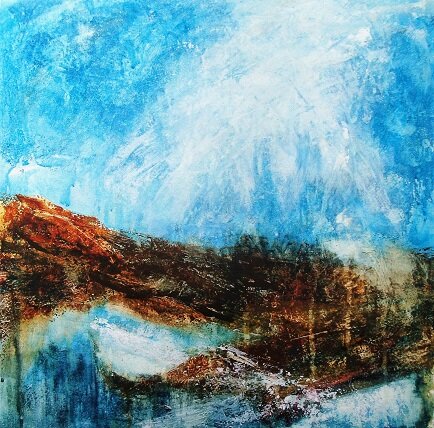
And it is this alchemy I wanted to capture in a series of eight paintings I have called Sky Fall.
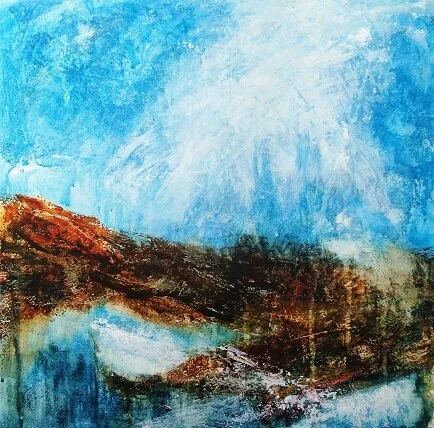
Sky Fall 1
They are abstract in that they are at a remove from representational likeness but they are all drawn from locations around the local shoreline — Ravensheugh Sands, St. Baldred’s Head…. and Sandy Hirst: the curved sweep of the north-facing shore of this shingly spit can be seen in more than one of these pictures.
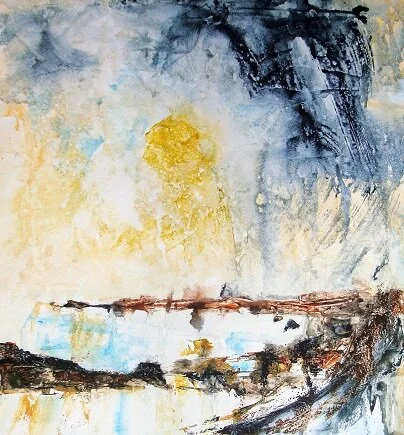
Sky Fall 2
I soon became attached to Sandy Hirst, this fragile lobe of sand and shingle hanging out into the Tyne Estuary. I walk there often and make a point of going there every equinox and solstice. A bit pagan, perhaps, but at these times I get a sense of sky and sea, and salt marsh and estuary as one, and I am part of it.
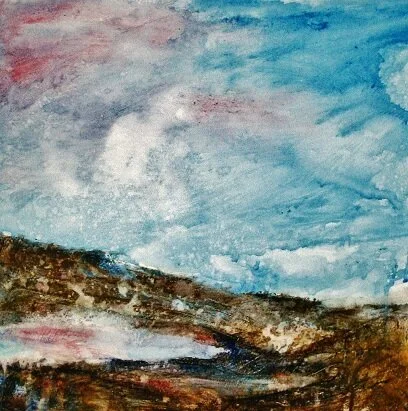
Sky Fall 3
It was with these paintings that I began my experiments with gesso. Each picture is 36cm square. I wanted them to be square to give breathing space for the sky. I used rough watercolour paper, taped it down and and used a 2 inch household brush to apply a coat of gesso. This is a plaster-based medium often used as a ground for acrylic, indeed, sometimes mixed with it. I sloshed it on thickly to create a good texture.
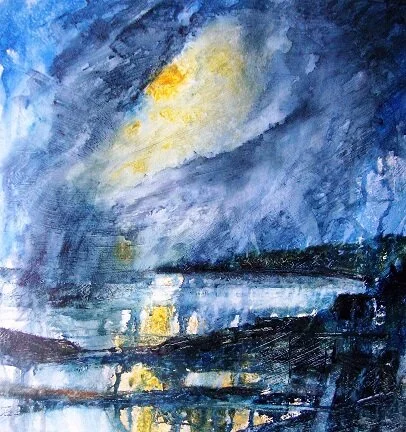
Sky Fall 4
It is porous, of course, but not nearly as absorbent as watercolour paper. Hence, the watercolour paint remains fluid and workable, floating on the surface. Even when the painting is finished, it is wise not to spill water on it.
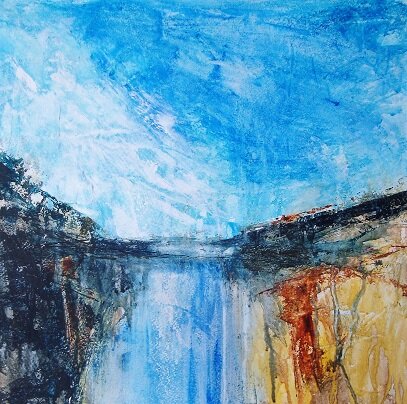
Sky Fall 5
I left the gessoed surface overnight to dry out. Then, before painting, I sprayed it with water using an old kitchen-cleaner bottle. Then, with photographs and sketchbook as a rough starting point, I just dived in — almost literally going with the flow. the watercolour paint immediately running into the watery spray and doing its own thing. Tilting the board at different angles I encouraged the paint to run in certain directions.
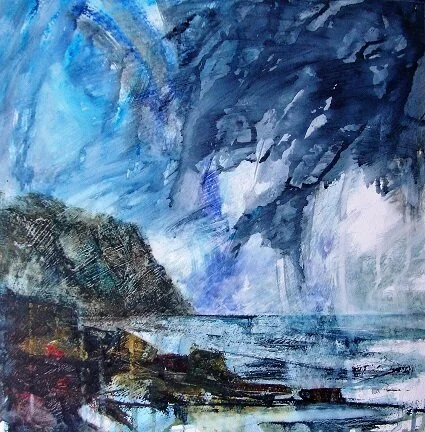
Sky Fall 6
I used a fairly limited range of colours in these paintings: cadmium yellow, with the odd touch of lemon yellow, cerulean blue, small amounts of ultramarine, raw umber, burnt sienna, Payne’s grey and the occasional smudge of crimson. I used large brushes and to define rock and shore features I scraped and spread and sliced the wet paint with a palette knife. One of the advantages of the gesso ground is that you can splash or spray clean water on painted areas, then lift out the colour with a tissue or rag to create a mottled effect. I do not underestimate the element of chance and accident in this process. Sometimes it seems as if the picture is painting itself and I am just manoeuvring it a bit here and there.
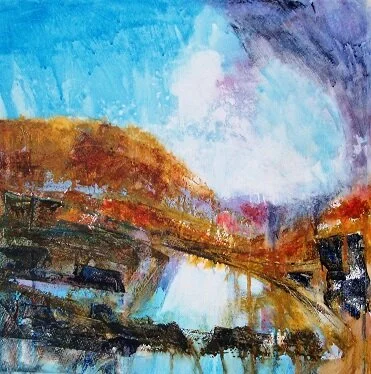
Sky Fall 7
My last Sky Fall is, I suppose, the most abstract. Planes of sea, sky and shore shot through with the fire of the sun and its reflection. Abstract in the sense of an image abstracted from the literal, the physical likeness. to convey a feeling or an idea. That’s what I wanted to do in these Sky Fall pictures.
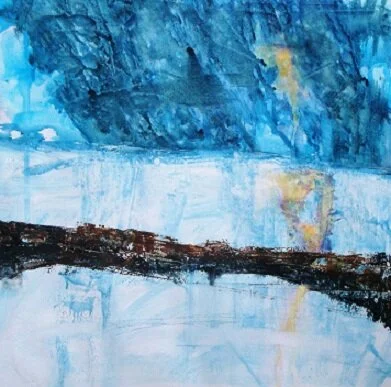
Sky Fall 8
I am now looking out at a sky without a hint of blue, a grey, lockdown sky. It is good to look back at other times and other skies with their energy and scintillating light, skies to lift the spirit.