Stories
Someone said that ‘homo sapiens’ was not so much the intelligent ape but the storytelling ape. I get the Radio Times every week and looking down the schedules most of what I see are stories — soap operas, drama series, plays, films. We love stories and we love ‘reality’ best when it becomes a story — the never ending soap opera of contemporary politics, the affairs of royalty, for example. It is no accident that they are called news ‘stories’. We even make TV dramas about people who are not yet dead!
It is the same with our individual experience of life. Things happen, we witness them somehow, then they become memory and memory becomes fiction through the alchemy of the unique algorithms that constitute our personalities. For each of us the world is an illusion of sorts.
.
So these three poems are stories, not historical documents. They spring from the mind of a now ageing man transposed to the perceptions of a young boy. Yes, I had a grandma whom I visited when she lived alone in a little house and, yes, I had an Uncle Derek….. or was he a cousin once, twice, removed? I don’t know. I have vague recollections of seeing them, of ‘events’, There are faded black-and-white photographs somewhere. But the poems belong to the realm of fiction — hearsay, family mutterings overheard by young ears, leavened with shards of what I take to be clear, sharp memories but which I suspect have been honed and polished by time and imagination.
Gran
Packed off in the school holidays to stay,
I saw her on the platform through the smoke.
She met me with a hug that smelt of bread,
then sat me by the window of the bus
that ground and rattled through the lamplit streets
to her back-to-back on the cobbled edge of town.
After tea I helped her with the fire,
lugging up the scuttle with both hands,
balancing the coals on a tent of sticks.
Before the spitting blaze she let me sit
in Grandad’s ancient rocking-chair and hold
the green bottle he’d put a ship inside.
She hummed along to the Black and White Minstrels,
knitting a tea-cosy from ends of wool.
I tried to fathom how the matchstick masts
and canvas sails got through a bottleneck
the size of my twelve-year-old middle finger.
Then after ovaltine and custard creams
she gave a sigh and sent me with a kiss
upstairs to the narrow bunk beneath the skylight.
I sank into the feather mattress, watched
the empty square of night swell to a sea
with me aboard and clinging to the rigging.
Then on the edge of dreams I caught her talking
through the floorboards, low and insistent,
sometimes rising to a question-mark
until I fell into a ghostless sleep.
When I came down in the morning I found,
propped by my breakfast bowl the green bottle
she’d taken from the mantelpiece first thing
and pushed into the neck a scrolled message
in blue capitals, FOR MY LITTLE SAILOR.
I tried to speak but she was looking away,
kneeling on the rug before the fireplace,
sweeping the dead embers from the hearth.
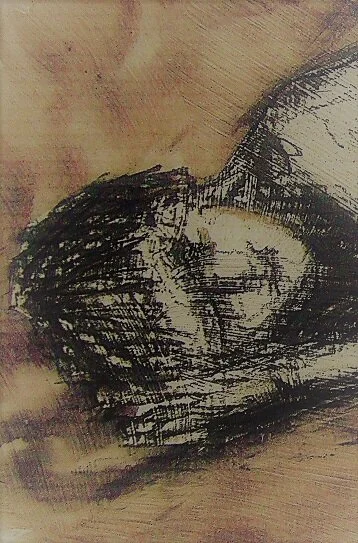
Uncle Derek’s Motorbike
‘He’s in the shed,’ Great Aunt Elsie said.
You always were, and through the scullery’s
boiled potato fug I chased the echo
of your tinkering spanner to catch you
kneeling on the earth floor, burly and intent
in your brown overalls, a carburettor
scattered round you like a constellation.
You chucked me on the chin and let me be
your little helper, when I’d hold
a gasket, fetch the big screwdriver
from the bench or dab a finger of grease
on the cogwheel.
Then you hoisted me atop
the padded saddle and I’d stretch across
the petrol-tank to reach the handlebars.
My throat revved through the gears, the road
rushed past beneath me in my reckless dream.
But when my face frowned into that question-mark
you chortled gruffly, ‘When you get old enough.’
So every time you rode out, valiant
in your double-breasted greatcoat,
goggled and leather-capped, a warrior
astride the roaring beast you tuned to a purr,
I bit my lip, sniffed at the blue smoke left behind.
I never did get old enough, of course.
I stood in the empty shed the day
you didn’t come home, watching the fenland rain
wash down and the truck splash into the yard,
a pile of mangled steel in the back.
They fished it from the dyke and found you
in a field of sugar-beet, all angles.
In the porch Aunt Elsie bawled into her apron.
*
When my thin skin smooths the pages of a book
or primly holds a poet’s pen,
I think of your giant, oil-smudged hands,
those spud-thick fingers that could thread a tiny screw
or set me giggling when they dug me in the ribs.
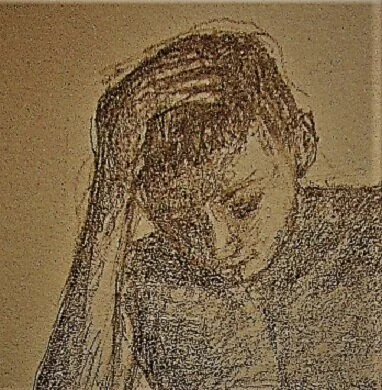
And yes, I knew what it was like to hide under the stairs. When I wrote ‘The Cupboard Under the Stairs’, I had just become aware of Google Earth, a digital facility whereby you could zoom in from somewhere in the upper atmosphere to anywhere on earth, right down to street level. At the time I was only dimly aware of the advances in big tech. and AI that were taking place. In my poem, Google’s surveillance stops at the roof. It would be a different story now, when your smartphone can recognise your face and fingerprints and Alexa can eavesdrop on your family arguments. What would Google not know about the house beneath the roof tiles and the souls that dwelt therein? And as for the troubled youth under the stairs it would know considerably more about him than his predilection for atlases.
The Cupboard Under the Stairs
If you google-earth it you’ll spin down
through layers of thin cloud, dip below
hazy blue horizons, cruise over yellow
Africa then a dense and half-lit Europe,
till hurtling beyond a pastoral of small fields
you swoop to a halt above a red-roofed crescent
on the edge of a minor Midlands town.
A van parked outside number 32, perhaps,
but nothing more, beneath the tiles nothing
of ice and silences, dinner cold on the table,
a bed half slept-in. You won’t uncover
the sunless loft, peer down landings, stairs or,
rounding the bottom step into the hall,
peek into the cupboard under the stairs
where you’ll have to imagine the vacuum-cleaner,
the box with Christmas lights, the paper-chains
and twists of tinsel, half-empty paint tins,
candles and matches by the fuse-box,
and, crouched in the narrow wedge at the back,
the boy with a bicycle-lamp whose faltering beam
blinks over Gifford’s Atlas of the Universe.
His finger spans the craters of the moon.
The orbits of his eyes turn with the planets,
burn with suns, wheel out to nebulae
and swirling galaxies. His brain pulsates
with supernovae bursting across light-years,
stretches through the static of deep space
for the merest echo of when it all began.
The lamplight flickers and the battery dies,
but not before his screaming head explodes
with a bang so big it silences the slam
of the front door, feet thudding up the stairs.