Hailes
A new month. March stretches before me like the blank pages of my diary. So many avenues of activity and entertainment are cut off. But at least I can still walk, and I don’t think I am breaking any rules by driving a few miles along the road on this first day of March to go for a walk. It’s not a long walk but enough to stretch the legs and clear the head.
I am setting off early from the village of East Linton to walk to Hailes Castle and back. I am taking my camera with me and will make some watercolour sketches from the photos….
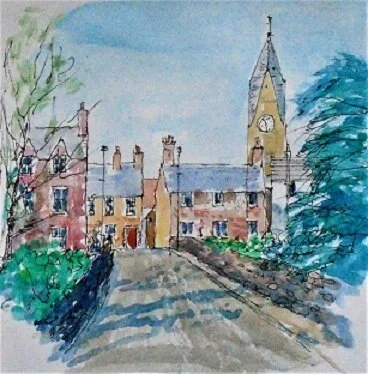
Leaving East Linton
I leave the village past a row of cottages, cross the main Haddington road and join the narrow lane to Hailes. The last house on the right is a stately affair with a monkey-puzzle tree in the garden.
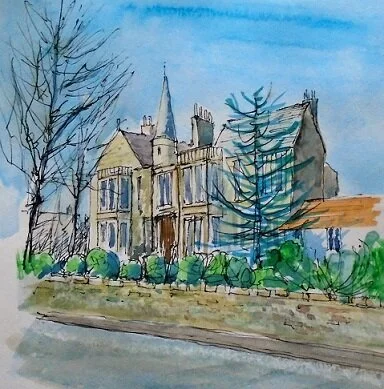
Large house with monkey-puzzle tree
Soon I leave the dwellings behind and I am in the countryside. A steep slope drops down to the north, to the valley of the River Tyne. On the other side, fields rise gradually to the domed hill of Traprain Law, a prominent protrusion in the gently undulating landscape, created as it is from volcanic rock.
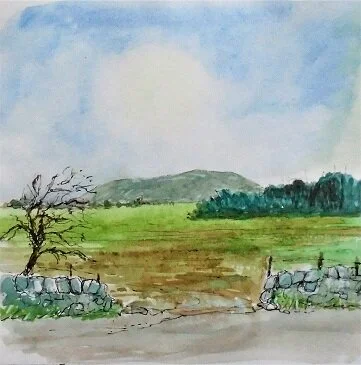
Sun over Traprain Law
When I walk along country lanes like this I feel I should have a bundle tied to a stick slung over my shoulder. A song comes to mind — the opening of Vaughan Williams’ cycle, ‘Songs of Travel’. It is called ‘The Vagabond’, set to the words of Robert Louis Stevenson. I start singing it:
Let the blow fall soon or late,
Let what will be o’er me;
Give the face of earth around,
And the road before me.
Wealth I ask not, hope nor love,
Nor a friend to know me;
All I ask, the heaven above,
And the road below me.
Luckily, it is a quiet road, though a couple of sheep over the fence look up from their grazing somewhat bemused.
Ahead, the span of the road bridge carrying the A1 over the valley comes into view. It is an exposed structure and sometimes the valley acts like a wind tunnel. Lorries have been known to blow over. I pass beneath it, the massive concrete legs and spars like the bones of some gigantic futuristic monster.
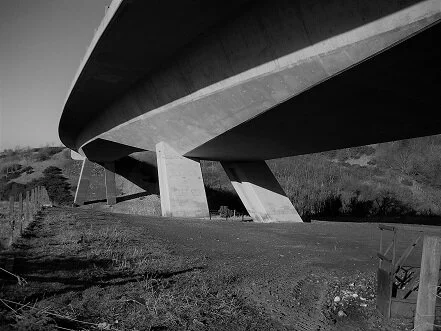
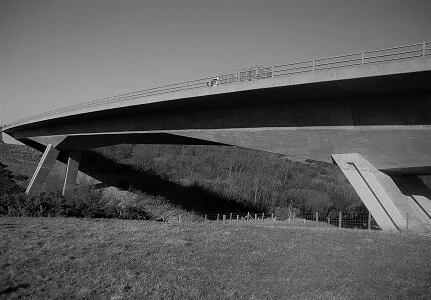
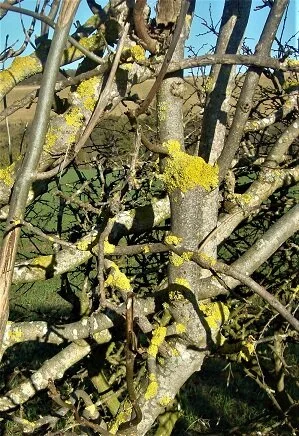
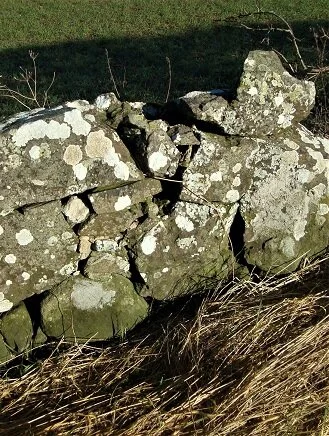
Beyond the bridge I tramp on, taking in the details of the natural world around me: the ever blooming gorse, the birds — chaffinches, a party of long-tailed tits, a couple of jackdaws, all getting more active and vocal by the day. The trees, still wintry but with a chilly green fuzz of opening buds. I stop to examine the lichens on the wizened thorn tree and the limestone wall beneath. Lichens are fascinating, not single organisms but a mixture of fungus and algae which need each other to exist. They establish the mutual give-and-take of a symbiotic relationship. I have often thought we could learn a lot from lichens.
Before long the lane dips down to the tiny hamlet of Hailes, two or three houses and some outbuildings. Beyond an old shed I glimpse the castle ruins.
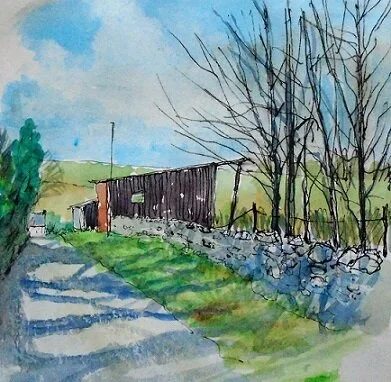
The lane into Hailes
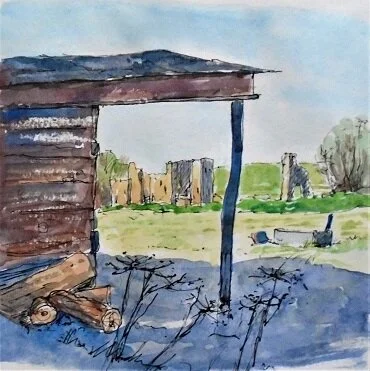
The Castle
I stop beneath a tree where a robin is giving his querulous song all he’s got, furiously defending his territory. The dip in the road seems to act like an echo chamber….it’s not only the robin; a wren tuts away in the hedge bottom, a great tit squeaks in a conifer behind me, and from over the fields comes the drumming of a great spotted woodpecker. A veritable cacophony of birdsong!
And so I arrive at Hailes Castle and enter the grounds through an iron gate. I cross a little rill and walk up the path to the ruins. There was a fortified manor house here, perched on a high, rocky outcrop above the River Tyne, in the 13th Century. It belonged to a Northumbrian family, the Gourlays. It later passed to the Hepburns who extended and embellished it. Like other castles in the area — Dunbar, for example — it has Mary, Queen of Scots, connections. During Henry VIII’s attempts to have her married to his son, Edward, the castle was captured by the English. Lord Grey of Wilton noted in 1548 that ‘the house is of such excellent beauty within as I have seen of any in England’’. Some twenty years later, Mary is said to have stayed here shortly before her ill-fated marriage to James Hepburn, Earl of Bothwell. A century later the castle was severely damaged by Oliver Cromwell after the Battle of Dunbar in 1650 in his advance on the Scots. The place eventually fell into disrepair and was used by local farmers to store grain.
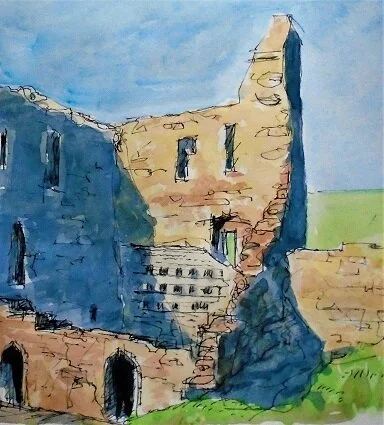
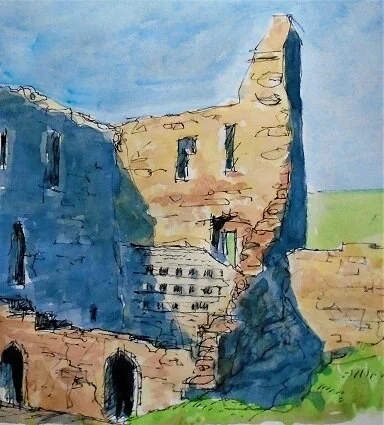
Castle ruins with ‘doocot’
Parts of the high curtain walls remain as do two towers between which is a large main hall, now open to the sky, and vaulted cellars below, where bread was baked and ale was brewed. An extension of the east tower has what’s left of a dovecote, or ‘doocot’ as is the word in these parts. If you peer over the railings on the northern edge of the site, you look down the steep drop to the Tyne swirling along below. I take more photographs, then perch on some masonry and get out my flask of coffee. I am not alone. Two small boys, supervised by their grandparents, are jumping off a low wall and rolling down the grassy slope. A scrap of conversation strikes up. They have seen an otter, the grandad tells me, down on the river bank. Later, when they have gone, I look over the railings again but see no otter. I am jealous. I did see one a few years ago, but further east beyond East Linton, and then it was only its head and snout as it nosed down the middle of the river.
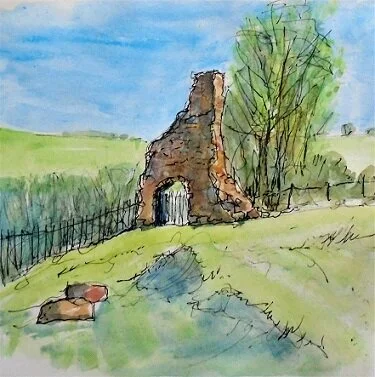
More ruins
I leave the castle behind and retrace my steps up the road past the old hut, then turn off down a footpath to the river. As it descends it becomes a sunken lane, the sulight glinting through the shadows of the trees.
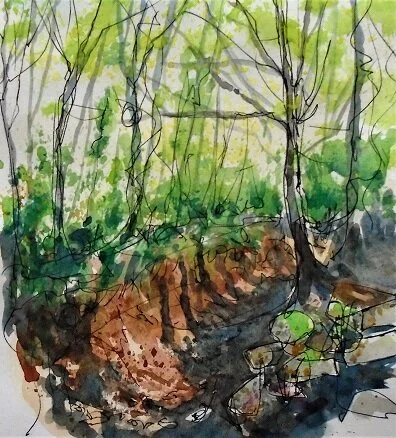
Path to the River
And looking down I see a side-channel, a still blue slip of water reflecting the willowy trees beyond.
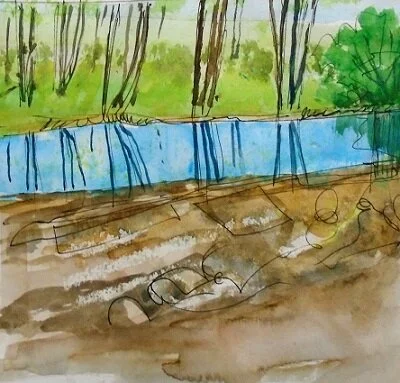
Reflections
Then to the river, the Tyne, which rises in marshy ground near Dalkeith, south of Edinburgh to the west, and flows down through Haddington and East Linton before issuing into Belhaven Bay and the Firth. I cross the long wooden footbridge to the north side and walk back to East Linton along the riverside path. The river banks are galaxies of snowdrops, and further on, reaching back into the trees, are hosts of daffodils just about to flower. In a week or so the place will be ablaze with them. Daffodil, the Lenten Lily, originally white, according to the story….Persephone, the beautiful daughter of Zeus and Demeter, wound a wreath of them round her head; when she was abducted by Pluto and lay asleep, his touch turned the flowers golden yellow.
I emerge from the cover of trees, come across a wooden bench and sit down for a while, the great concrete road bridge once again in sight. I chastise myself for my earlier mood of gloom about the long days of lockdown ahead, when all that matters is this moment, with the river rippling by in its ceaseless flow.
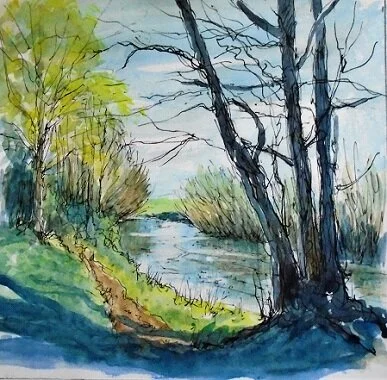
River Tyne