Et In Arcadia Ego
I park my ageing Cavalier in a muddy layby next to the wood. I fix the crook-lock in place — there is a sign warning of thieves ‘operating’ in the area. I climb over a wooden fence and cross a deep, overgrown ditch. This is a bit of what’s left of Grim’s Ditch, thought to be part of a defensive earthwork of the Britons of the ancient Kingdom of Elmet, dug to deter the advancing Saxons.
I enter the wood and break into a jog. I often come here for a walk or a run; it is a good training route, no great distance but short, sharp ascents and descents all the way round. In a shady hollow I slow up when I hear a bird call I think I recognise, a rather sad, plaintive ‘piu’. Looking into the bushes I spot the rosy pink breast of a bullfinch and this cheers me for it is a secretive bird, not often seen. I pick up speed again and descend to cross a little silty stream before the steep climb through trees to the summit of a knoll.

The Greek Temple
And so arrive at the Greek Temple, for these are the grounds of Temple Newsam House, so called not because of this particular structure but because in the 12th Century the place was occupied by the Knights Templar, one of the orders of militant Christians whose mission was to protect pilgrims on their way to Jerusalem and to fight the Muslim Infidel. From this vantage point a vista opens up across a shallow valley to the house itself on the rising ground beyond. The Greek Temple where I pause to look at the view was built around the time that none other than Capability Brown was landscaping the grounds. It is a folly from which the owners could proudly show off their estate. It was, of course, also the focal point of the view from the house.
In truth it is now a sad edifice. Roof tiles are missing, the rear wall is scrawled with multicoloured graffiti and the floor is spattered with pigeon droppings and evidence of other nights. This is not, after all, the leafy shires but the eastern outskirts of Leeds, the tower blocks of its vast housing estates looming in the distance. But it was, three centuries ago, part of that fashionable attempt to recreate Arcadia in the grounds of the nation’s country houses — the artificial lakes, the carefully positioned copses and groves, and pseudo-classical delights such as this temple, all designed to amuse and divert the aristocratic landlords and their guests. And, indeed, as I turn away I catch a faint sense of that Arcadia as I descend through the rhododendrons and beech trees and arrive at the little lake below.
Arcadia is to this day a region of Greece in the Peloponnese Peninsula. Its limestone geology with its rills and springs, caves and shake-holes meant that the only productive use of the land was sheep-rearing. It was this setting that was idealised by early Greek writers such as Theocritus, who invented a style of pastoral poetry which celebrated the gentle beauty of nature and the virtuous simplicity of rustic life. The genre was later Romanised by Virgil in his ‘Eclogues’ and the landscape of this fictionalised Arcadia with its waterfalls and sylvan groves was inhabited by youthful shepherds who spent the time lolling around, playing their flutes and having singing contests while pretty maidens looked on winsomely.
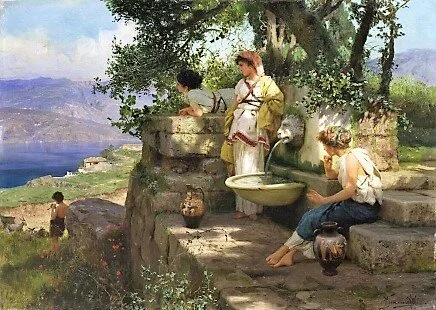
A Vision of Arcadia
Thus the Arcadian peasant, far from the weather-beaten, gap-toothed, reeking yokel of reality.
But….Et In Arcadia Ego. It was in the Louvre on an Art School trip that I found myself looking at Poussin’s ‘Arcadian Shepherds’.
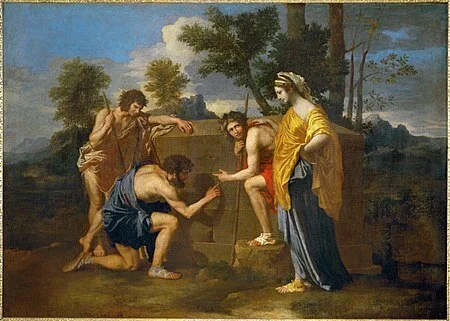
Painted in 1638 by Nicolas Poussin 1594 - 1665
It depicts three handsome, surprisingly muscular, scantily draped peasants accompanied by a somewhat matronly woman with a hint of pregnancy about her. They have stumbled upon a large stone tomb which has appeared, tardis-like, in their sylvan landscape. On its side are carved in Latin capitals the words ET IN ARCADIA EGO. Their fingers trace the lettering and judging by their faces they are trying to work out what it means. What it says is, Even here in Arcadia am I….Death. A baleful reminder of our frail mortality, made more explicitly in an earlier painting by Guercino, round about 1620, in which a large skull sits in the foreground while the peasants look on somewhat unsettled.
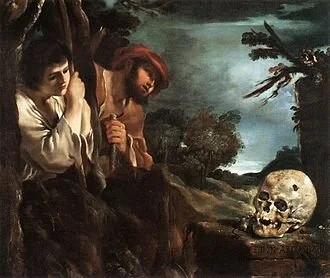
Et In Arcadia Ego by Guercino 1591 - 1666
I cross the bridge over the lake and begin to ascend the gradual slope up to the house. I pass not shepherds but pensioners and teenage mums, a party of adults with learning difficulties and their infinitely patient carers, and a long-haired youth on a skateboard.
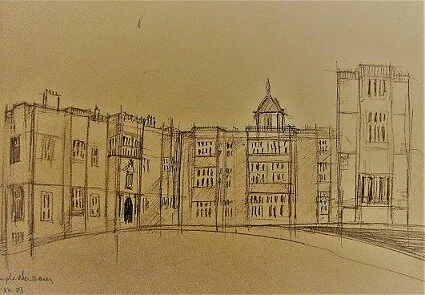
Temple Newsam House
I arrive at the house, an imposing Jacobean mansion which largely reached its present form in the mid 17th Century. Before this time, among the noblemen who occupied the place was the Earl of Lennox whose son, Henry Stuart, Lord Darnley, was the one time husband of Mary, Queen of Scots and father of the future James I. But now the lords have departed along with the nymphs and shepherds and Temple Newsam is run by Leeds City Council. It is open to public view; you can wander round the wood-panelled rooms and admire the paintings and statuettes, the roped off four-poster beds and the chairs you can’t sit on and emerge with a bit of culture tucked under your belt.
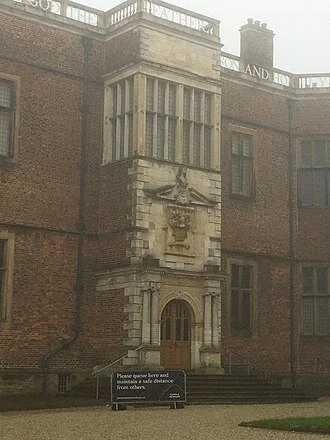
The Entrance
You can then head for the old stable-block, now a cafe and adjoining shop, have your tea and scones and depart with a propelling pencil stamped with ‘A present from Temple Newsam.’
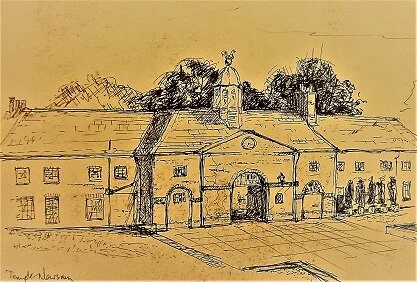
The Stable Block
I circle the house, skirt the formal garden to the south, stride out back down the grassy slope, pass the youth propelling his board back up the hill, then grind back up the hill to the Greek Temple. But I do not stop this time. I run round the far side of the wood, catching a glimpse of two roe deer prancing through the trees. I cross Grim’s Ditch again and see to my relief that my car is still there.
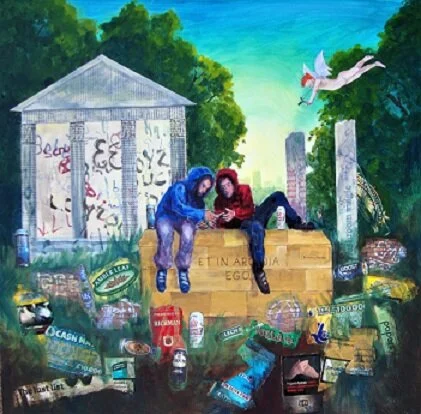
Later, I do a painting called, unremarkably, ‘Et In Arcadia Ego’. Not shepherds but a couple of youths in hoodies perch on the tomb and light a joint. A punk cherub takes aim. The Greek Temple is in the background, resplendent with its graffitied murals. The tower blocks of East Leeds rise hazily in the background. These youths are unlikely to understand the Latin inscription and wouldn’t be much bothered if they did. They have no illusions about Arcadia. Their defacing and littering of the temple, though crude, is not an assault on classical culture or even aristocratic pretension. It’s just a good place to hang out, have a smoke and a few cans of lager. And it’s a good wall to have a go at with your spray-can.
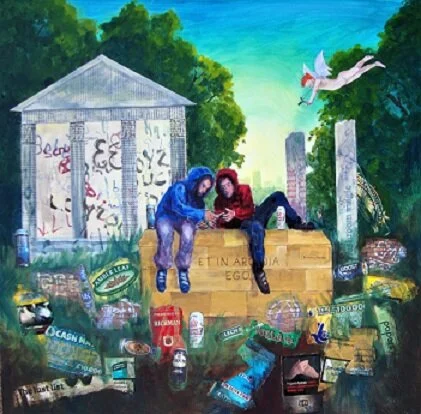
Et In Arcadia Ego……..