Sea Pictures with Brahms
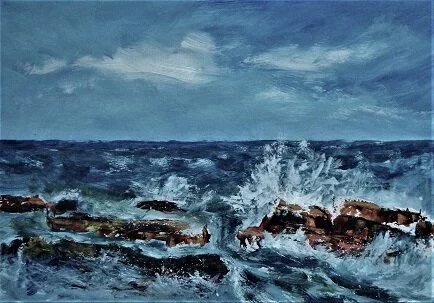
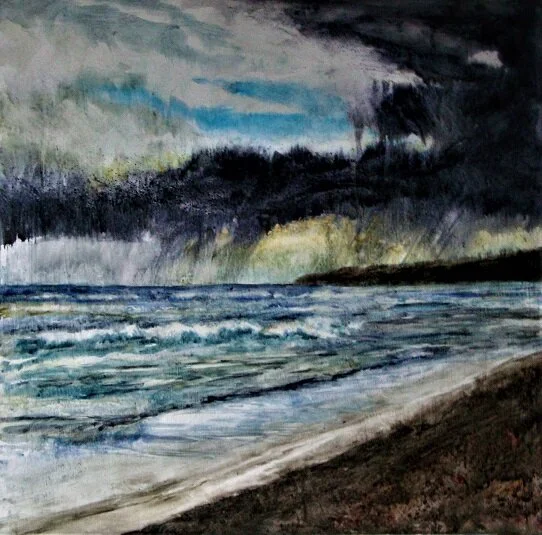
Recently I painted three sea pictures. I had been for an early walk along the shore, through the dunes to the expanse of Ravensheugh Sands, eastwards where the sun was an ochre smudge in an unsettled sky. I took some photographs as the light constantly changed and the sea with it.
I had some sheets of hardboard, 4’ x 2’, which I cut in half to produce 2’ sq. panels. I painted them with white emulsion then primed them with gesso, a plaster based medium which can be used as a ground for painting. I applied it liberally with a three inch household paint-brush to produce a thick, robust texture. Gesso is often used as a ground for acrylics but I have been using it for some time as a base for watercolour. The paint does not set and adhere as it does with paper but floats on the surface, remains workable and can be moved around or lifted out indefinitely. Indeed, the only drawback is that the finished painting is relatively unstable, so you should avoid spilling water on it and if it is any good, get it framed!
Here is the first one I did. Before sloshing the paint on I sprayed the surface with water into which the paint runs and slides and does its own thing, as in the sky here. The crests of the breaking waves were lifted out with a brush and clean water.

*
Those of you who have read my ‘Shorelines’ blog might recall that I always put some music on to accompany my painting and that it is normally Bach. Not long ago, however, I had a musical revelation of the kind I experienced often in my moody teenage years when I became addicted to classical music and was greedily lapping up all that the then Third Programme offered up. Those days have passed and I have to admit that I am a rather unadventurous music lover. I reckon I’ve got recordings of everything I shall ever want — when I do buy a CD now it tends to be a different performance of something I’ve already got. But to my revelation! I have listened to and loved the music of Brahms for decades.
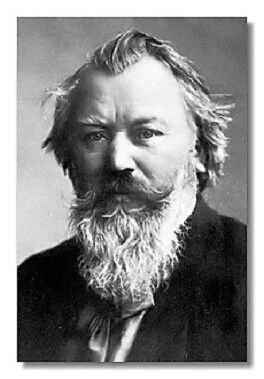
Johannes Brahms 1833 - 97
One of my first LPs was Brahms’s Third Symphony, Karl Bohm conducting the Vienna Philharmonic on the Decca Ace of Clubs label. I soon got to know all four symphonies — the Third is still my favourite, I think — and the concertos — not forgetting the lovely Double Concerto for violin and cello. I have had the pleasure of singing in his German Requiem on several occasions. Later, I came to the chamber music, the trios, quartets, quintets, even sextets, all bursting with fine tunes and rich harmonies.
For all this, the solo piano music had somehow passed me by. I was familiar with some of the late pieces, the Intermezzi, Op.117, for example, but I had no recordings of them. When I investigated the many available versions, I discovered that Brahms had written far more piano music than I was aware of: three sonatas, for example, as well as sets of Fantasies, Rhapsodies and Ballades. I saw that Naxos, that superbly enterprising label and friend of the financially challenged, had all this music in their catalogue so I went ahead and ordered four CDs, a sort of ‘lockdown’ present.
*
Here is my second sea picture. The rain clouds have cleared away, the sky has brightened and the waves are rolling happily onto the smooth sand.
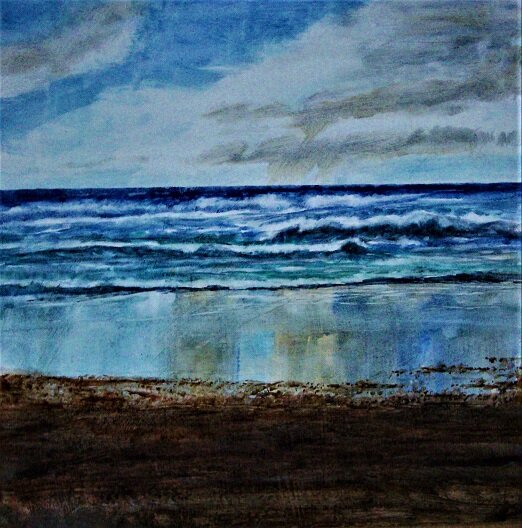
I used few colours: cerulean blue, a natural for the sky, a bit of ultramarine, mainly for mixing, a dash of cadmium yellow and raw sienna, then raw umber and burnt sienna for the foreground. These colours are good for the reddish earth and rocks of these parts. Also, I like to add little touches of viridian to the sea.
*
Great excitement when my CDs arrived, and with them my revelation. This was a month or so ago and I have listened to little else since…indeed, the music is playing now as my two fingers tap away on my keyboard. What puts the seal on the experience is that it is played by Idil Biret, a pianist of Turkish birth whom, to my shame, I had never heard of. Now in her 79th year, she was a precocious talent and studied with Alfred Cortot and Wilhelm Kempff. At the age of 11 she gave a concert with Kempff in Paris.

From around 16 she has performed worldwide and has a huge discography to her name. These Brahms recordings were made about thirty years ago. Her playing is both tremendously muscular and beautifully delicate, just right for Brahms’s wide, chunky chords and his wistful, dreamlike passages. There is one piece of music I have become particularly smitten with, the fourth of his Ballades, Op.10. It starts with a lyrical, rather Chopinesque, tune which leads into a central section of great mystery and harmonic strangeness. Brahms marked this passage to be played ‘Col intimissimo sentimento, ma senza troppo marcare melodia’ — with the most intimate feeling but without overemphasising the melody.. Why would a composer not want his tune to be emphasised? Several performances of this ballade can be found on You Tube by such great pianists as Emil Gilels, Michelangeli, Alfred Brendel and others. They do not seem to take much notice of Brahms’s marking. Michelangeli plays with rapt attention, but it is all tune. However beautiful it is. I can’t imagine this is what Brahms intended. So I returned to my recording by Idil Biret and she gets it….the chorale-like tune seems to hover in and around the accompaniment of cross rhythms and ambiguous harmonies with hauntingly beautiful effect. I can’t get it out of my head.
*
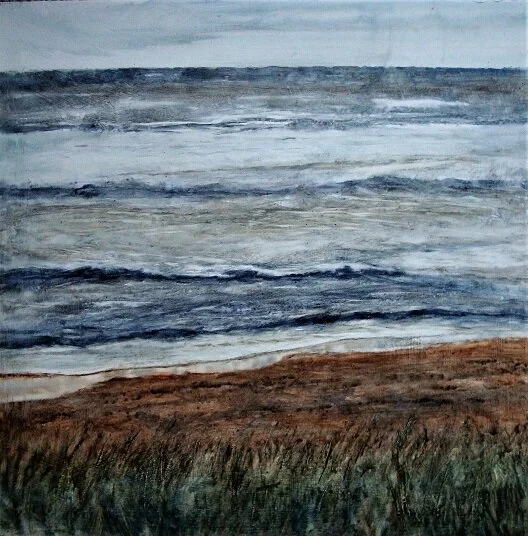
And so to my last sea picture. The sky has changed once again. The sea reflects its quiet greys, the waves now breaking in gentle ripples along the shore. The planes of sea and sky and foreshore sing their own ballade.
*
Brahms was a young man, barely into his twenties when he wrote that ballade. His great friend, Robert Schumann, had just been admitted into an asylum having tried to commit suicide by jumping off a bridge into the Rhine. Brahms helped manage Schumann’s business affairs and look after the household along with Clara Schumann, to whom he became strongly attached.
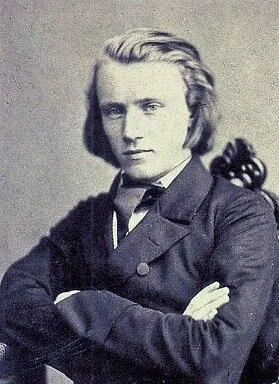
Brahms in 1853, around the time he wrote the Ballades Op.10